
Last updated September 22, 2026
Free on-site gate assessment - hinges, posts, and your LiftMaster or Nice gate operator checked before anything is quoted
The assessment is free and the quote is the invoice.


 Before
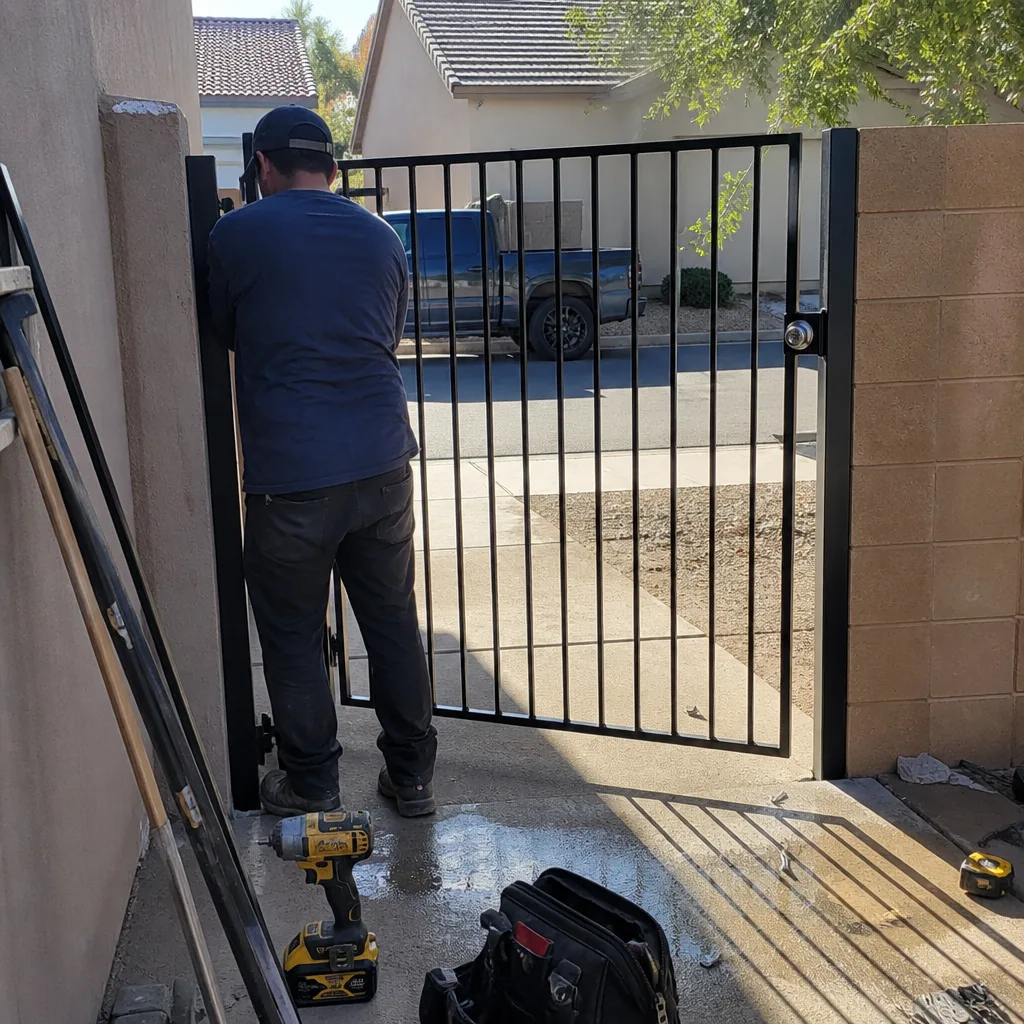 After
After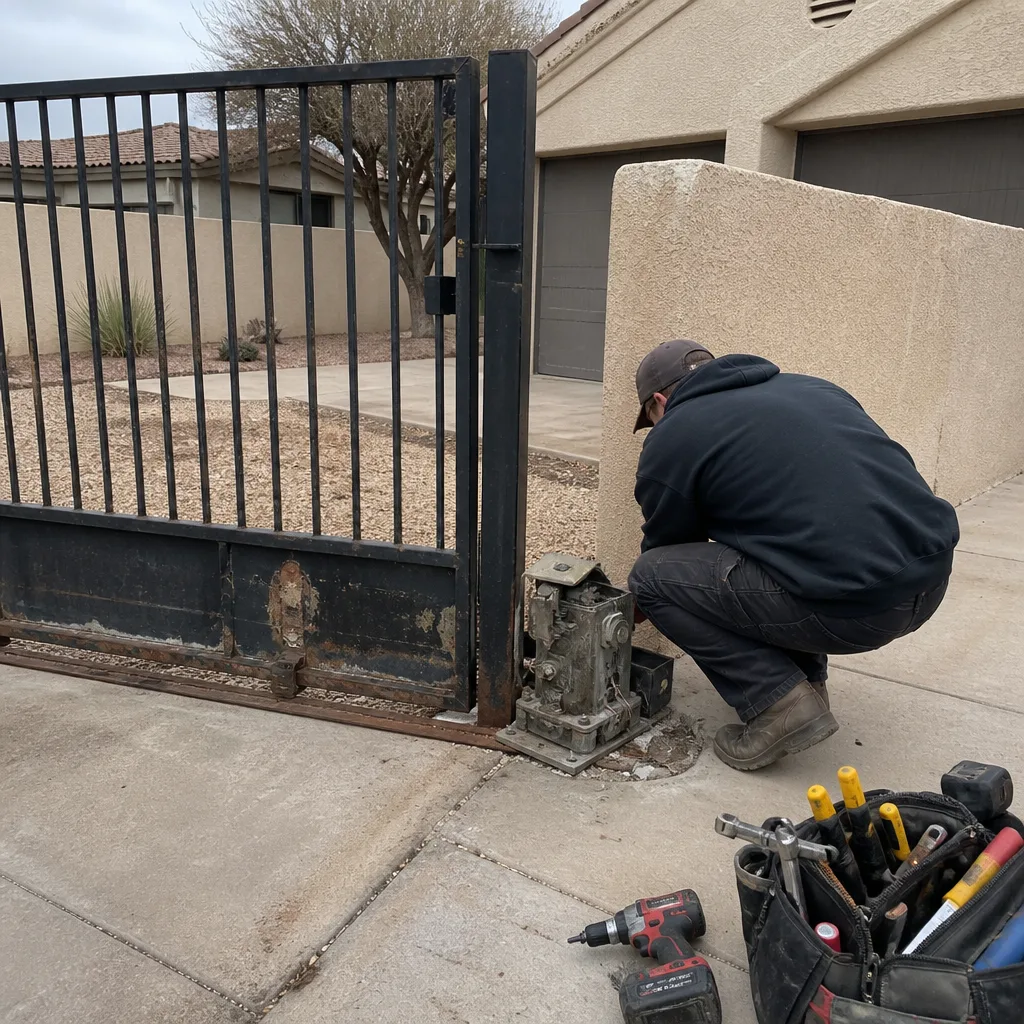 Before
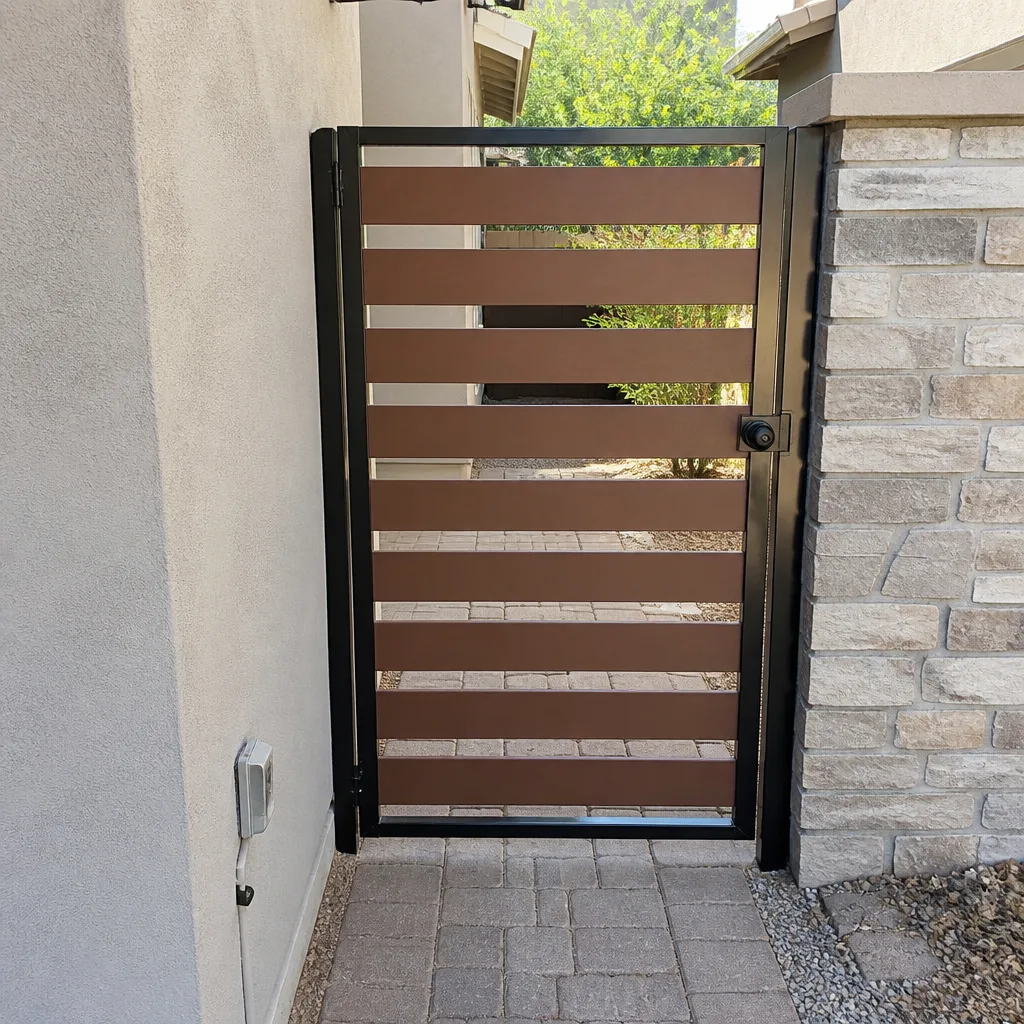 After
After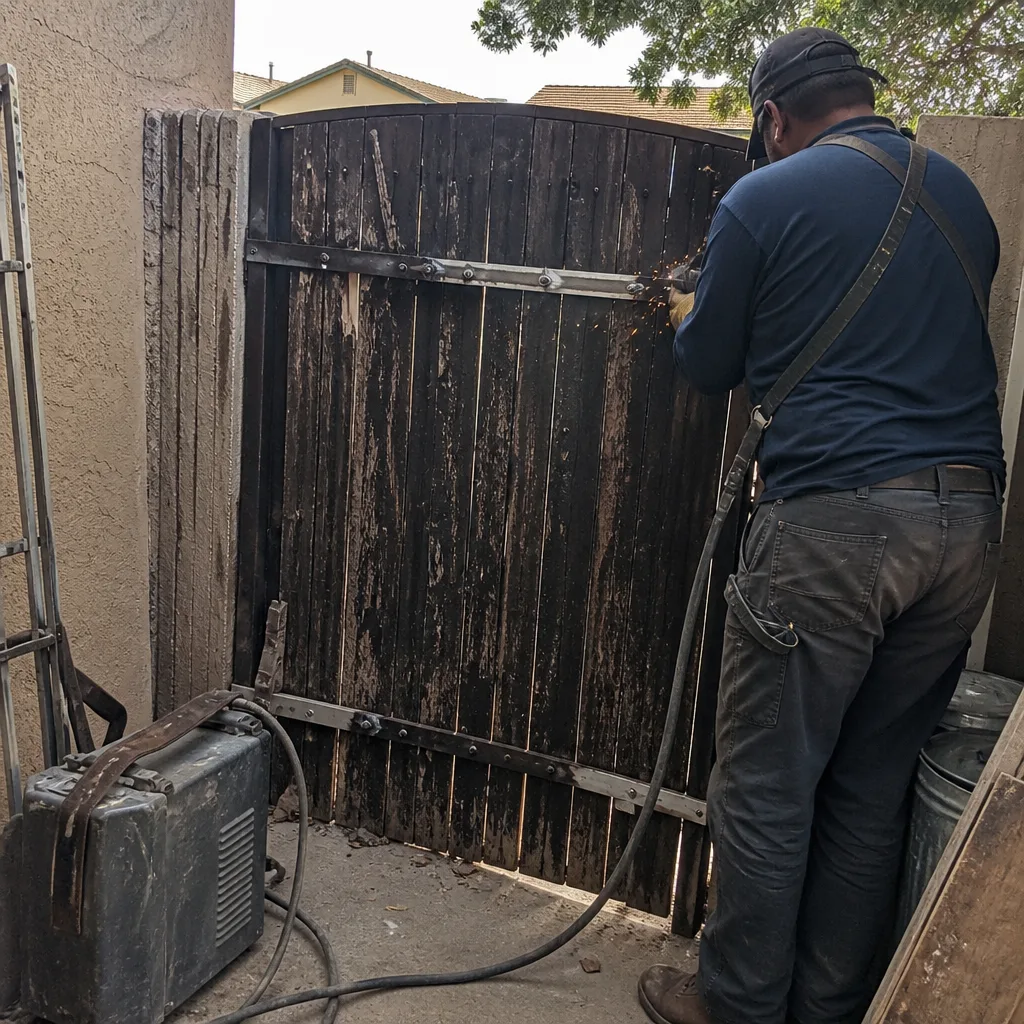 Before
 After
AfterHow to Hire a Gate Repair Contractor in Gilbert: A Step-by-Step Guide
Calling three gate companies for quotes and getting three different verbal numbers isn’t comparison shopping - it’s three different technicians describing three different scopes of work with no way to know which problem any of them actually plan to fix. In Gilbert’s gate repair market, where residential communities range from historic Agritopia to newer builds in Morrison Ranch and Power Ranch, we’ve watched homeowners accept repair quotes that varied by 400% for the same stated symptom. Our Complete Guide to Gate Repair in Gilbert shows you how to turn hiring a gate contractor into a documented process, not a trust exercise. You’ll learn the exact questions to ask before anyone schedules a visit, how to compare bids when line items don’t match, and what a proper job record looks like before you sign off.
Quick Answer
To hire a gate repair contractor in Gilbert, verify their Arizona ROC license and insurance status online, demand a written estimate that specifies parts and labor separately, and confirm they’ll provide photographic documentation of the completed work. A legitimate Gilbert gate contractor should agree to all three without hesitation; anyone who won’t put the scope and price in writing before work starts is signaling that their final invoice may not match their opening number.
Table of Contents
- Why Verbal Estimates Fail in Gilbert’s Gate Repair Market
- Step 1: Verify Before You Call - License, Insurance, and Work History
- Step 2: What to Ask Before You Schedule the Visit
- Step 3: How to Read and Compare Written Estimates
- Red Flags Specific to Gate Repair Contractors in Arizona
- Step 4: What Your Completed Job Record Should Contain
- Common Mistakes to Avoid
- When to Call a Professional
- Frequently Asked Questions
- The Bottom Line
 Before
 After
AfterWhy Verbal Estimates Fail in Gilbert’s Gate Repair Market
Gilbert’s housing stock spans three decades of rapid growth, from the 1990s ranch-style homes near Val Vista Lakes to the custom builds in Adora Trails and Whitewing. That variety means gate systems vary enormously - from basic Mighty Mule openers on DIY-installed swing gates to commercial-grade DoorKing systems on estate properties. A verbal estimate can’t capture this complexity, and contractors who rely on them know it.
Here’s what happens instead. One technician hears “my gate won’t close” and quotes $180 for a photo-eye realignment. Another hears the same symptom and quotes $650 for a control board replacement. Both could be right, or both could be wrong - but without a written scope tied to a physical inspection, you’re not comparing prices, you’re comparing guesses.
The Vance Gate Repair Gilbert home page explains our approach: under The Haven Standard, every visit starts with a written price before any work begins. We developed this practice because Adrian Vance’s background in commercial access-control work (starting in 2014) taught us that undocumented repairs create repeat calls. A commercial site can’t afford downtime because the last technician didn’t record a limit-switch setting. Residential customers in Gilbert shouldn’t either.
Gilbert’s climate compounds the documentation problem. Summer temperatures above 115°F degrade control board capacitors and warp plastic gears in operators from every brand we service - LiftMaster, FAAC, BFT, Linear, Viking, Ghost Controls, DoorKing, Elite, and Mighty Mule. A technician who doesn’t photograph the thermal damage and record the part number is leaving the next technician (or the same homeowner next summer) to rediscover the same failure pattern. We’ve replaced control boards in Power Ranch that failed twice in eighteen months because the first installer never documented the original part number or the ambient temperature rating - a problem our Seasonal Gate Repair Care for Gilbert: Year-Round Homeowner’s Guide addresses directly.
The fix is simple in concept: every estimate in writing, every repair documented. Most Gilbert gate contractors don’t do this because it takes longer and exposes them to accountability. That’s exactly why you should require it.
Step 1: Verify Before You Call - License, Insurance, and Work History
Before you schedule any contractor, verify three things independently. Don’t ask them to email proof - look it up yourself.
ROC License Lookup
Arizona requires gate repair contractors to hold a valid Registrar of Contractors license. Search the Arizona ROC database using the company’s legal name or the owner’s name. Check three details:
- License status is “Active,” not “Suspended” or “Expired”
- The license classification covers the work you need (CR-60 for pre-manufactured steel, CR-56 for welding, or a commercial classification for access-control systems)
- No pending complaints or disciplinary actions in the last 24 months
A contractor working without a valid ROC license can’t pull permits if your repair requires one, and their insurance may be void. We’ve encountered unlicensed operators in Gilbert who subcontract to licensed holders and split the fee - a practice that leaves you with no direct contractual relationship to the licensed party.
Insurance Verification
Ask for a certificate of insurance (COI) naming you as additional insured for the project duration, or at minimum showing current general liability and workers’ compensation coverage. Gate repair involves 150+ pound metal panels, high-tension springs on some swing-arm systems, and 110V or 220V electrical work. A technician injured on your property without workers’ comp becomes your homeowners insurance problem.
Permit Record Search
Gilbert’s Community Development Department maintains online permit records. Search the address of any recent job the contractor references. Permits for gate operator installation or structural welding should appear in the database. No permit record for a “recent installation in Morrison Ranch” means either the work was unpermitted or it didn’t happen. Both matter.
Google reviews tell you about customer experience, but permit records tell you about compliance habit. A contractor who skips permits to save time will skip documentation steps too.
Step 2: What to Ask Before You Schedule the Visit
The phone call before scheduling reveals more than most homeowners realize. Ask these questions in this order, and note the exact wording of each answer.
- “Do you provide a written estimate before any work begins, or do you diagnose and then quote on-site?” The correct answer: a written estimate with the price, scope, and parts specified before tools come out. If they say “we’ll look at it and tell you,” you’re getting a verbal number that can shift.
- “Is your diagnostic fee separate from the repair price, and do you waive it if I proceed with the repair?” This sounds like a consumer-friendly policy, but it creates a perverse incentive: the technician is now motivated to find something repairable, because an “all clear” diagnosis pays nothing. We charge a flat service call that includes diagnosis and documentation; the repair price is quoted separately, in writing, with no pressure either way.
- “What format does your job documentation take - photos, written report, wiring diagram?” If the answer is “we’ll give you a receipt,” that’s not documentation. Under Haven Standard Clause 4, every Vance visit produces a photo log of what was found, what was adjusted, and what was installed, plus a written record of part numbers and settings. You should receive a copy before the technician leaves.
- “Do you service the brand of operator I have, or do you only install new ones?” Some Gilbert contractors carry only one brand and steer every customer toward replacement. We service nine major automation brands - including LiftMaster, DoorKing, Elite, and Mighty Mule - because repair is often the right answer and replacement should be a last resort, not a default.
- “Will I receive the technician’s name and photo before arrival?” Background-checked, uniformed technicians who are identified in advance aren’t a luxury - they’re a basic security practice for anyone entering your property.
How a contractor answers these questions tells you whether they run a documentation practice or a verbal-estimate shop. In our experience, the ones who hesitate or reframe (“well, we can email something after”) are the same ones whose invoices don’t match their opening numbers.
Step 3: How to Read and Compare Written Estimates
Once you have two or three written estimates, the real work begins. Line items rarely match exactly, so you need to unbundle until you’re comparing identical scope.
Common Line-Item Mismatches
One contractor quotes “gate operator replacement, $1,850.” Another quotes “operator: $1,200, labor: $340, arm bracket: $180, safety edges: $210, disposal: $75, total: $2,005.” The second looks higher, but the first may not include safety edges or disposal - extras that appear on the final invoice.
Ask each contractor to break their quote into these categories:
- Parts (with manufacturer part numbers)
- Labor (hours or flat rate)
- Materials not part of the operator (concrete, welding rod, wire)
- Permits and fees
- Disposal of old equipment
- Warranty terms (duration, what it covers, who honors it)
Without part numbers, you can’t verify that two “comparable” operators are actually equivalent. A LiftMaster CSW200UL and a Mighty Mule MM560 are both swing-gate operators, but they’re not interchangeable - the LiftMaster is rated for continuous duty and has a 5-year warranty; the Mighty Mule is residential-duty with 2-year coverage. A contractor who won’t specify the part number is asking you to trust their judgment without verification.
The Power Run Question
In Gilbert’s newer developments - Seville, Encanterra, Layton Lakes - gate operators often sit 50+ feet from the nearest electrical source. Some estimates assume you’ll hire an electrician separately; others include the trenching and conduit. This single item can swing a quote by $800-$1,400. Ask explicitly: “Does this price include the power run from my panel to the operator location?”
Safety Edges and Entrapment Protection
Arizona adopted UL 325 safety standards for automatic gate operators, and Gilbert enforces them through building inspections. Any new operator installation requires entrapment protection - typically photo-eyes and safety edges. Some contractors quote operators without these devices to hit a lower number, then add them as “required by code” after work starts. A proper written estimate specifies the safety devices included and cites the applicable standard.
Comparing Warranty Terms
Don’t just compare duration - compare what happens when something fails. Our Gate Repair in Gilbert service includes the 365-Day Done Right Promise: if any repair isn’t right, we make it right with no argument, no fee, no expiration within that window. Some competitors offer “1-year parts and labor” but require you to pay a new service call to diagnose the failure, effectively charging you to claim the warranty. Ask: “If this repair fails in six months, what do I pay to have it fixed?”
Red Flags Specific to Gate Repair Contractors in Arizona
Gilbert’s growth rate and housing turnover create conditions where low-barrier contractors thrive. Watch for these specific warning signs.
“Diagnostic fee waived with repair.” As noted above, this creates a conflict of interest. The technician who needs the repair to happen is diagnosing whether you need it. We’ve been called to Gilbert homes where a previous contractor declared a control board “fried” and quoted $780 for replacement; our documentation showed a loose low-voltage connection that took twelve minutes to secure and test.
Pressure to decide immediately. “I can do it today for this price, but my next opening is three weeks out.” Real scheduling constraints exist, but same-day pressure combined with a verbal-only quote is a classic tactic to prevent comparison shopping. A written estimate with a 10-day price hold serves both parties better.
No physical address or only a PO box. Arizona ROC records show the contractor’s registered address. Cross-reference it with their website. We’ve found Gilbert-area contractors listing “local” service while registered in Tucson or Phoenix with no local presence.
Brand exclusivity presented as expertise. “We only install LiftMaster” sounds like specialization, but it often means the technician can’t troubleshoot your existing DoorKing or Elite operator and will recommend replacement regardless of condition. True expertise is demonstrated across multiple brands, not enforced limitation to one.
Vague warranty language. “Fully warranted” means nothing. “One-year parts and labor, manufacturer’s warranty on operator, our labor warranty on installation” means something you can enforce. Ask for the warranty document before work starts, not after.
Cash-only or “check made out to me personally.” This breaks the paper trail and often indicates unreported income, which correlates with unlicensed or uninsured work. A legitimate contractor accepts multiple payment methods and provides a detailed invoice with their business name and ROC number.
Step 4: What Your Completed Job Record Should Contain
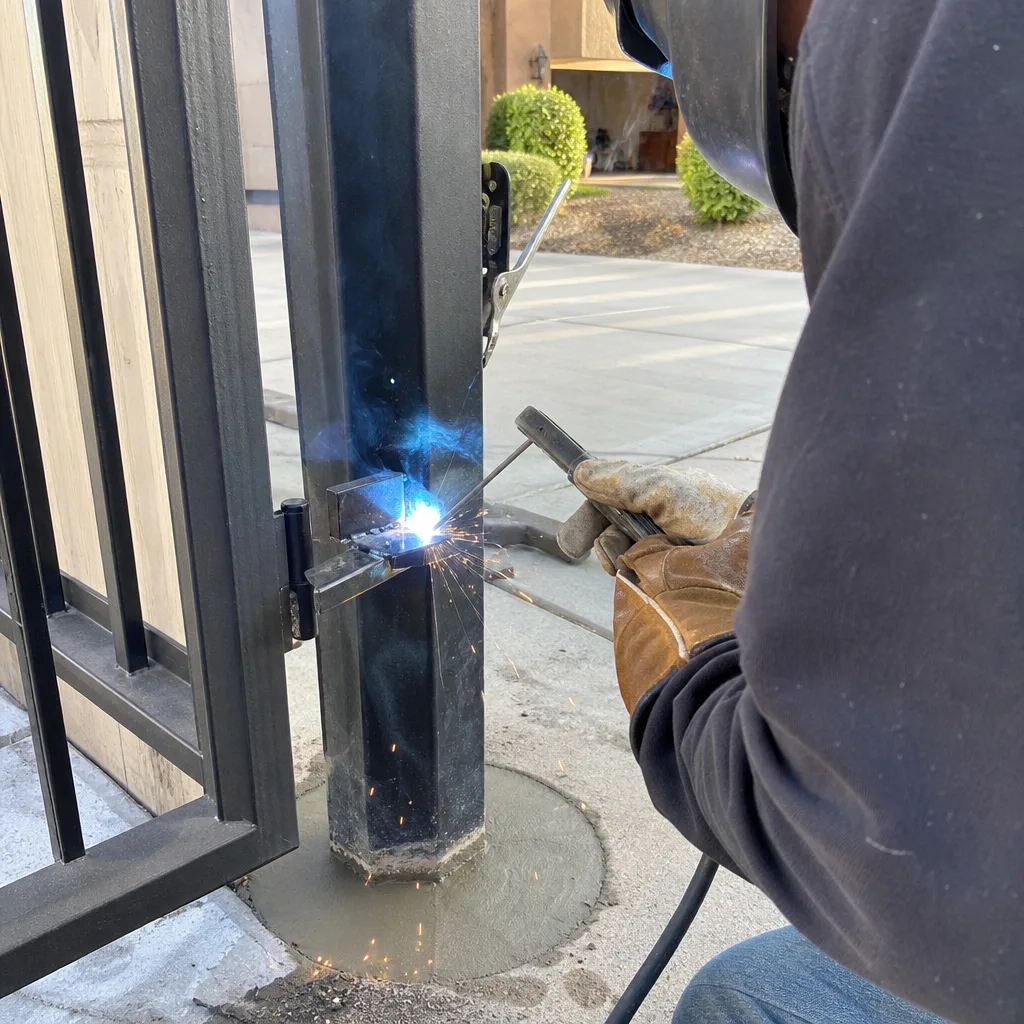
The job isn’t done when the gate moves. The job is done when you have documentation that the next technician - or you, in six months - can use to understand what was done and why.
Under Haven Standard Clause 4, every Gate Repair services visit produces this record. You should demand equivalent documentation from any contractor you hire. Here’s what belongs in it:
- Before photographs: The gate in its failed state, the operator with cover removed showing wiring condition, the control board displaying any error codes, the physical environment (grade, clearance, vegetation interference)
- Diagnostic findings: Specific measurements - limit switch angles, motor amp draw, battery voltage, photo-eye alignment in inches from specification
- Work performed: Each adjustment named and quantified - “reset close limit from 87° to 92°,” “replaced 12V 7Ah battery with model XYZ, measured 13.2V after charging cycle”
- Parts installed: Manufacturer, model number, serial number, date code where visible
- After photographs: The same angles as before photos, showing corrected condition
- Wiring diagram or connection record: For control board replacements, a sketch or photo of terminal connections
- Written invoice: Matching the pre-work estimate, with any changes initialed by both parties and explained
Why does this matter beyond accountability? Gilbert’s hard water and summer heat create predictable failure patterns. A photo showing calcium buildup on a photo-eye lens from 2023 explains why the same symptom recurs in 2025 - and tells you whether the original fix was incomplete or the environment is the real problem. Without the photo, you’re paying for the same diagnosis twice.
We’ve filed over 22,000 job records since 2014, every one with a written price before work started and photographic documentation when we left. That archive lets us tell a Gilbert customer in Seville Ranch, “We serviced this operator in 2019 - here’s the part number that was installed then, and here’s how it performed.” That’s not customer service; it’s evidence-based maintenance.
Ask your contractor before work begins: “What documentation will I receive when you leave, and in what format?” If the answer is “a receipt” or “I can email you something,” specify what you want. Their willingness to commit in writing predicts their willingness to deliver.
Common Mistakes to Avoid
- Accepting a verbal estimate because “it’s just a small repair.” Small repairs become large invoices when scope isn’t defined. A “simple adjustment” that requires a control board recalibration is $180 if quoted upfront, $450 if added as “discovered during service.”
- Comparing total prices without unbundling. The lowest total often excludes required components - safety edges, permits, disposal - that appear later. Line-item comparison prevents surprise additions.
- Assuming all “licensed” contractors carry the same coverage. A ROC license in a limited classification doesn’t authorize electrical work or structural welding. Verify the classification matches your job.
- Ignoring permit requirements for operator replacement. Gilbert requires permits for new automatic gate operator installations. Unpermitted work can block home sales and void insurance claims if someone is injured. The permit is the contractor’s responsibility, but the liability is yours.
- Not asking about response protocol for warranty claims. A warranty that requires you to pay a diagnostic fee to access it isn’t a warranty - it’s a deferred payment plan. Get the claim process in writing.
- Choosing based on speed of availability alone. Same-day service matters for security emergencies, but a contractor who can drop everything to reach you today may be underbooked for a reason. Balance availability with documentation practices.
- Failing to check if the contractor services your specific brand. A contractor who only stocks Mighty Mule parts will recommend replacing your functioning Elite operator rather than repairing it. Brand capability should match what’s on your property, not what’s in their truck.
When to Call a Professional
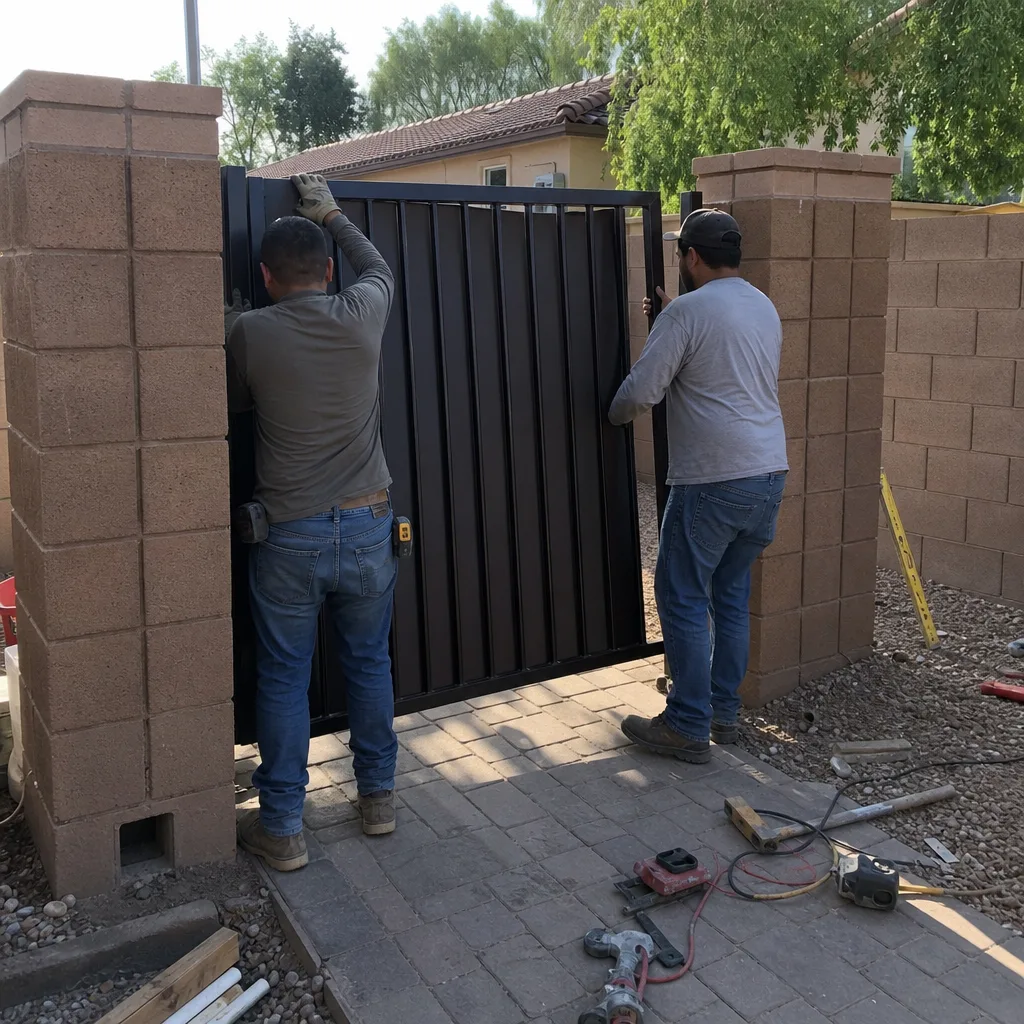
Some gate symptoms demand immediate professional attention - not because homeowners can’t observe them, but because the underlying causes involve components that can cause serious injury or property damage.
Call a qualified contractor if your gate exhibits any of these: the operator hums but the gate doesn’t move (stripped gears or bound mechanical components); the gate reverses randomly during travel (failed entrapment protection or erratic limit switches); visible damage to the gate frame or hinges after vehicle contact; any sparking, burning smell, or control board discoloration; or the gate moves manually but the operator doesn’t respond to any input.
These symptoms involve high-tension springs, electrical faults, or mechanical binding that can release stored energy without warning. Document what you observe - error codes, timing, environmental conditions - but don’t attempt disassembly.
Gate Installation in Gilbert and repair require specific tools and safety protocols. Vance Gate Repair Gilbert offers free estimates throughout Gilbert - call (520) 482-3109 to schedule a documented inspection with a written price before any work begins.
Frequently Asked Questions
Most residential gate repairs in Gilbert range from $180 for a photo-eye realignment or limit-switch adjustment to $1,400-$2,800 for a complete swing-gate operator replacement with safety edges and power run. Sliding-gate repairs typically run 15-20% higher due to track and roller complexity. Call (520) 482-3109 for a written estimate on your specific gate - estimates are free.
Repairs to existing operators and mechanical components generally don’t require permits, but replacement of an automatic gate operator does. Gilbert’s Community Development Department requires permits for new operator installations to verify UL 325 entrapment protection compliance. A qualified contractor should handle permit pulling as part of the project; if they suggest skipping it, that’s a red flag.
Search the Arizona Registrar of Contractors database at roc.az.gov using the company’s legal name or the owner’s personal name. Verify the license is active, the classification covers your work, and no disciplinary actions are pending. The license number should also appear on their website and any written estimate.
Most gate motors we encounter in Gilbert are repairable - control boards, capacitors, gears, and limit switches are all replaceable components. We service nine major brands including LiftMaster, DoorKing, Elite, and Mighty Mule, and we repair before replacing under Haven Standard Clause 1. Replacement becomes necessary when the operator frame is cracked, the motor windings have failed, or parts are obsolete - we’ll show you the specific failure and explain why repair isn’t viable.
A proper written estimate specifies: the symptoms reported and the diagnosed cause; each part proposed with manufacturer and model number; labor hours or flat rate; materials and permits; warranty terms with duration and coverage; and the total price with expiration date. See our more guides & resources for additional homeowner protection strategies. Under The Haven Standard, we deliver this in writing before any work starts - no exceptions.
For security-impacting failures - a gate stuck open, a failed operator leaving property exposed - same-day response is available from established contractors. For non-emergency repairs, expect 24-72 hour scheduling. Installation and replacement work is measured, ordered, and scheduled; promising same-day installation would mean cutting corners on measurement or permit review. Call (520) 482-3109 - a live person answers 24 hours a day to assess urgency and schedule appropriately.
The Bottom Line
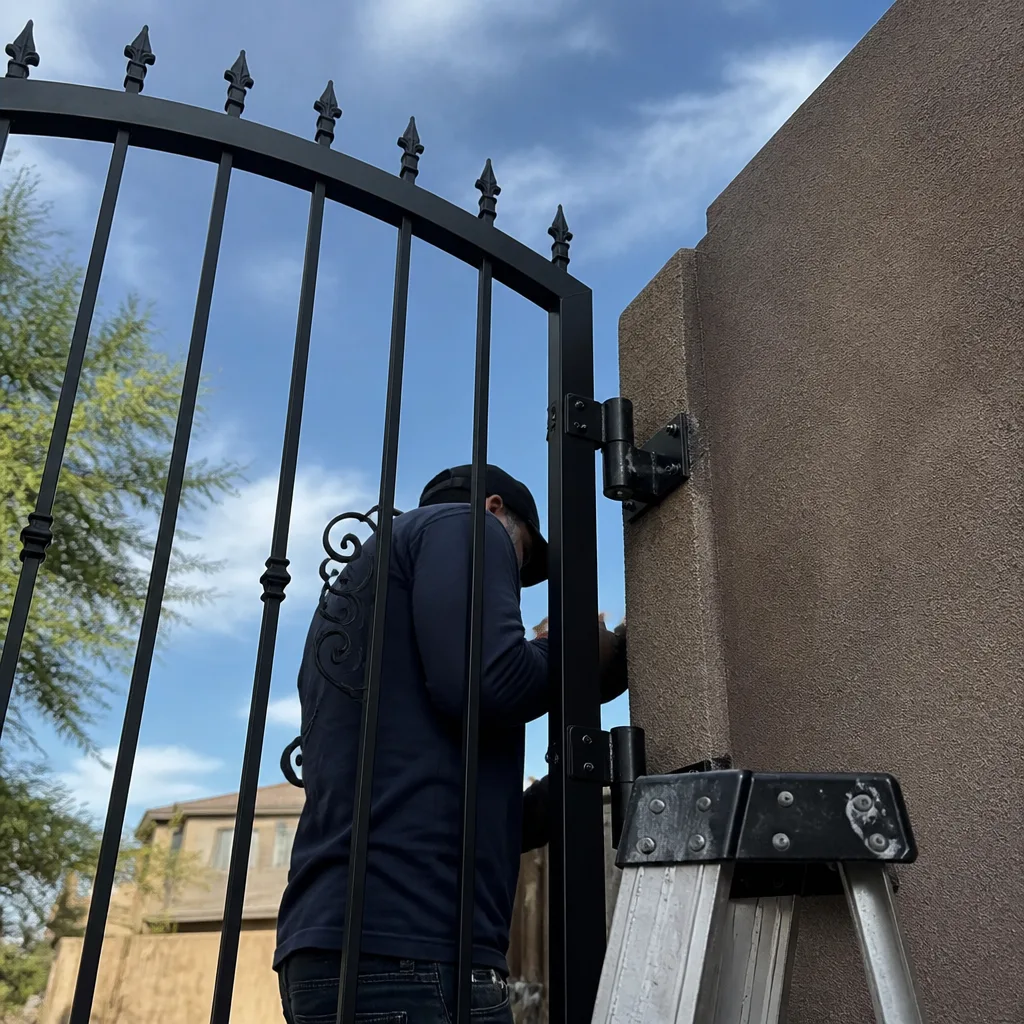
Hiring a gate repair contractor in Gilbert comes down to one principle: documentation beats trust. A written estimate before work starts, a verifiable license and insurance status, and a photographic job record when the technician leaves - these three elements separate professional practice from verbal-estimate gambling. The questions in this guide aren’t adversarial; they’re the same ones any careful technician would want answered if they were hiring work on their own property. We’ve applied them to 22,000+ jobs since 2014, and the homeowners who ask them upfront get outcomes that match their expectations.
Written by Adrian Vance, Owner at Vance Gate Repair Gilbert, serving Gilbert since 2014.