
Last updated September 22, 2026
Free on-site gate assessment - hinges, posts, and your LiftMaster or Nice gate operator checked before anything is quoted
The assessment is free and the quote is the invoice.


 Before
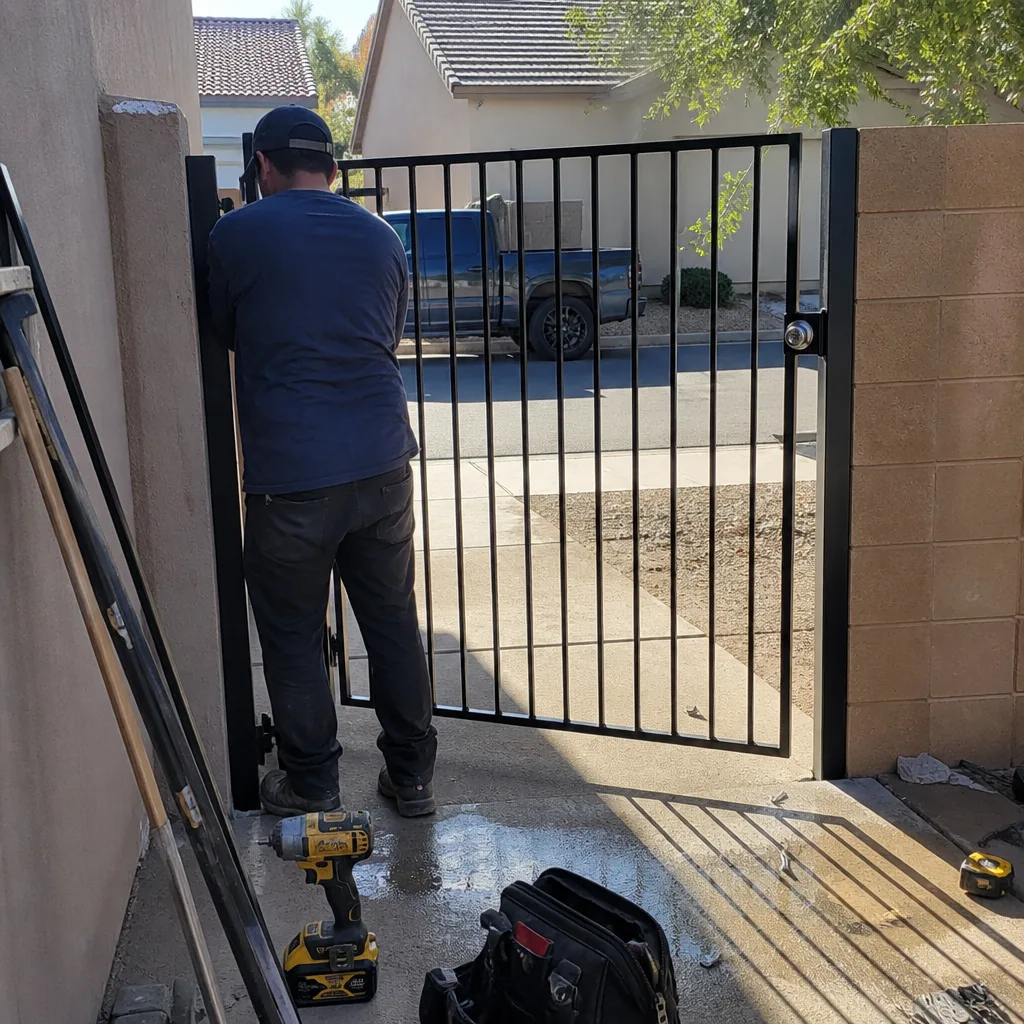 After
After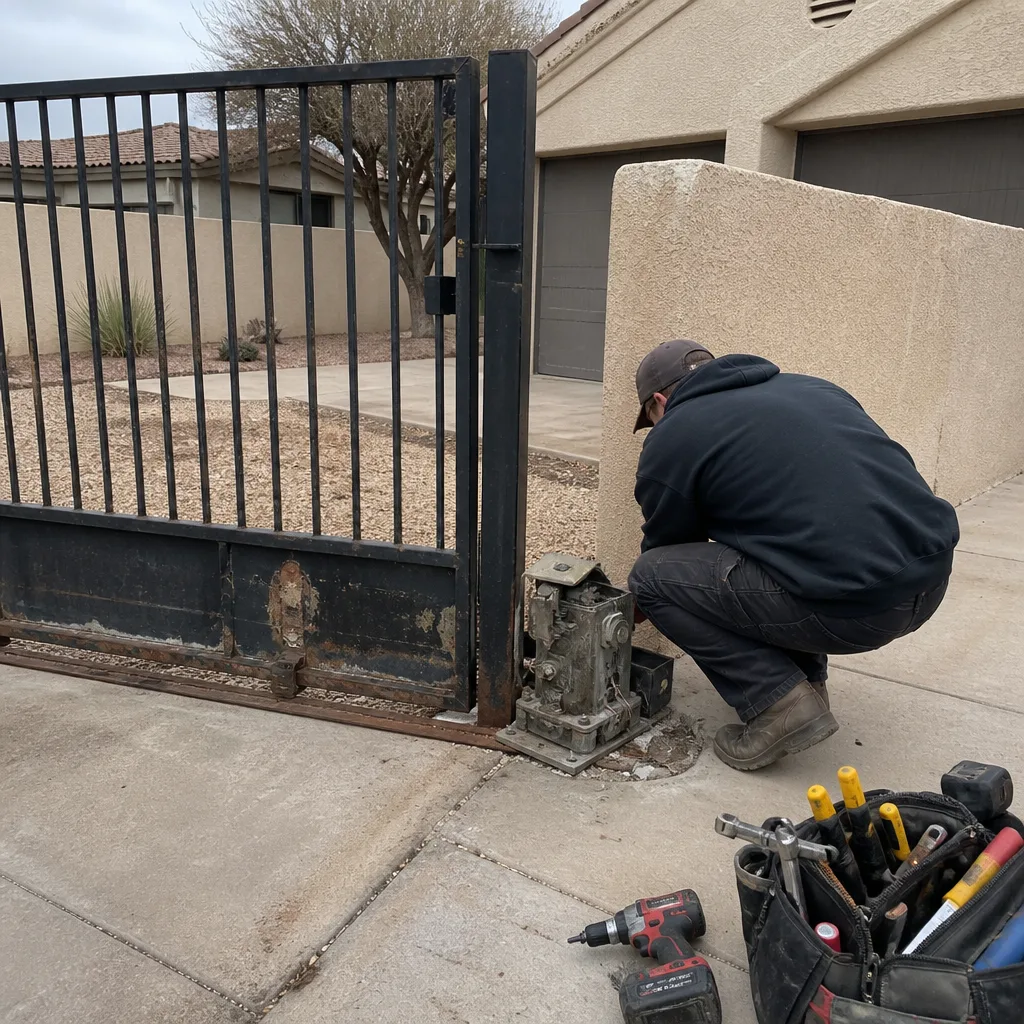 Before
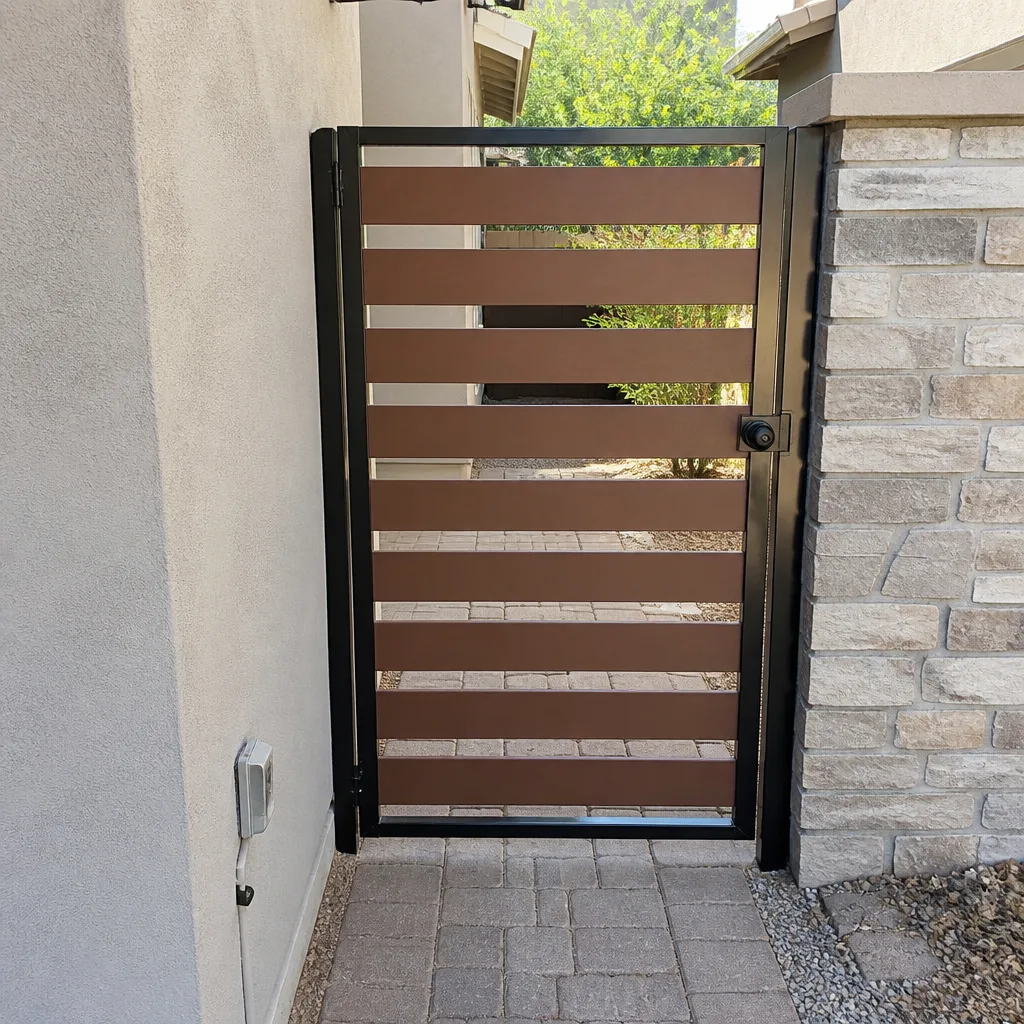 After
After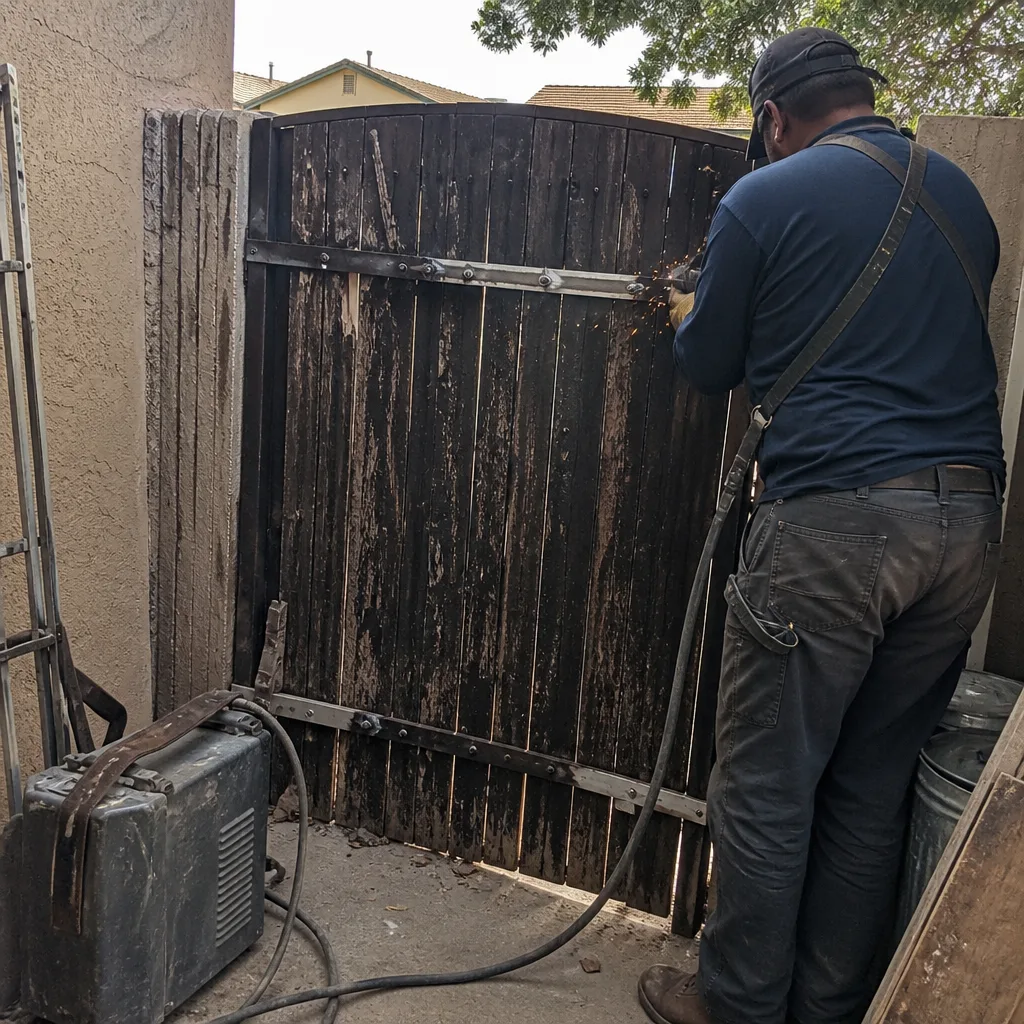 Before
 After
AfterGate Repair Maintenance Checklist for Gilbert Homeowners
The single most skipped item on every DIY gate checklist - verifying limit-switch travel distance - is also the item whose neglect causes the most expensive motor burnouts in high-heat climates. In Gilbert, where July concrete temperatures regularly exceed 140°F and dust infiltration accelerates wear on every moving surface, a gate motor that over-travels by even a few degrees runs hot enough to cook its own capacitor. We’ve replaced more gate motors in Gilbert homes that failed from calibration neglect than from actual component wear. This checklist follows the exact sequence our technicians use on documented service visits, with measurable benchmarks so you know what “normal” looks like versus what sends us a service call.
Quick Answer
A proper gate maintenance checklist for Gilbert homeowners includes monthly photo-eye cleaning and alignment verification, quarterly hardware torque checks and lubrication, semi-annual limit-switch travel measurement and battery voltage testing, and annual professional inspection of welds, underground loops, and motor internals through our Gate Repair services. Tasks should be scheduled around Gilbert’s climate calendar: pre-monsoon hardware checks in May, battery stress testing before August peak heat, and post-storm debris clearing in September.
Table of Contents
- Why Gilbert’s Climate Changes Your Maintenance Schedule
- Monthly Maintenance Tasks
- Quarterly Maintenance Tasks
- Semi-Annual Maintenance Tasks
- Annual Maintenance Tasks
- How to Document Your Baseline (The Haven Standard for Homeowners)
- Warranty-Safe DIY vs. Warranty-Voiding Work
- The Three Consumable Parts on a Replacement Schedule
 Before
 After
AfterWhy Gilbert’s Climate Changes Your Maintenance Schedule
Generic gate maintenance checklists assume four seasons and moderate humidity. Gilbert has two relevant seasons for gate systems: extreme dry heat and monsoon surge. Each creates distinct failure modes that don’t appear in manufacturer documentation written for national distribution.
UV degradation is the silent killer of gate components in Gilbert. The same polyethylene wire insulation rated for 10 years in Michigan degrades to brittle cracking in 3-4 years here. We’ve pulled control wire from a 2019 installation in Power Ranch that crumbled in our fingers - the copper was fine, but the jacket had turned to dust. Photo-eye lenses cloud with UV crazing, reducing infrared transmission enough to cause false obstruction errors.
Dust infiltration works differently than generic “debris.” Gilbert’s caliche dust is alkaline and abrasive. When it mixes with standard lithium grease, it forms a grinding paste that destroys bronze bushings in slide-gate rollers. The correct lubricant for Gilbert is a dry-film PTFE or silicone-based product that doesn’t attract dust - we specify this on every gate repair in Gilbert where we’ve found the wrong grease previously applied.
Monsoon surge exposure hits in July and August. A single storm can deposit enough debris in a track to stall a motor, and the humidity spike causes condensation in control boxes that were bone-dry for eleven months. Lightning-induced voltage spikes travel through underground loops and fry circuit boards - we’ve replaced DoorKing and Elite control boards in Val Vista Lakes and Agritopia within 48 hours of the same storm cell.
Here’s how we calibrate the maintenance calendar to actual Gilbert conditions:
- March-April: Pre-heat system verification - test battery under load before summer stress
- May: Pre-monsoon hardware torque check - wind loads increase dramatically during storms
- June-August: Weekly photo-eye cleaning during dust storm season; monthly battery voltage logging
- September: Post-monsoon debris clearing and loop integrity test
- October-November: Limit-switch recalibration after thermal expansion season
- December-February: Deep inspection window - moderate temperatures allow extended diagnostic time
Monthly Maintenance Tasks
These tasks take 15-20 minutes and prevent 70% of the emergency calls we receive in Gilbert. Do them on the first Saturday of each month, before the day’s heat builds.
1. Photo-Eye Cleaning and Alignment Verification
The photo-eye (infrared beam) is the most common failure point we find on residential gates. See Gate Repair Warning Signs: A Gilbert Homeowner’s Reference Guide for related symptoms. In Gilbert, UV crazing and dust accumulation combine to reduce signal strength.
- Power down the gate at the disconnect - never clean photo-eyes under power
- Wipe both transmitter and receiver lenses with a microfiber cloth dampened with distilled water; tap water leaves mineral deposits that attract dust
- Check alignment: the LED indicator on the receiver should show solid green, not flickering. A flicker indicates misalignment of 1/8 inch or more
- Measure the gap: place a straightedge across both housings. They should be within 1/4 inch of parallel, with no twist. In our documentation, we record the offset in sixteenths - “receiver housing rotated 2/16 clockwise” - so the next technician knows if drift is occurring
- Test the safety function: interrupt the beam during closing. Gate should reverse within 2 seconds
Warning reading: Receiver LED flickers or shows red; gate fails to reverse when beam is broken. Normal reading: Solid green, immediate reversal.
2. Track and Roller Debris Clearing (Slide Gates)
Gilbert’s mesquite leaf drop and monsoon debris create track obstructions that overload motors.
- Visually inspect the full track length for packed debris, especially at the low point if the driveway has any slope
- Remove debris with a stiff brush; compressed air blows fine dust into bearings
- Check roller condition: spin each by hand. Should turn freely with no grittiness or flat spots
- Verify roller-to-track clearance: 1/8 to 3/16 inch on each side. Less clearance causes binding; more allows gate rattle that loosens hardware
3. Visual Weld and Hinge Inspection (Swing Gates)
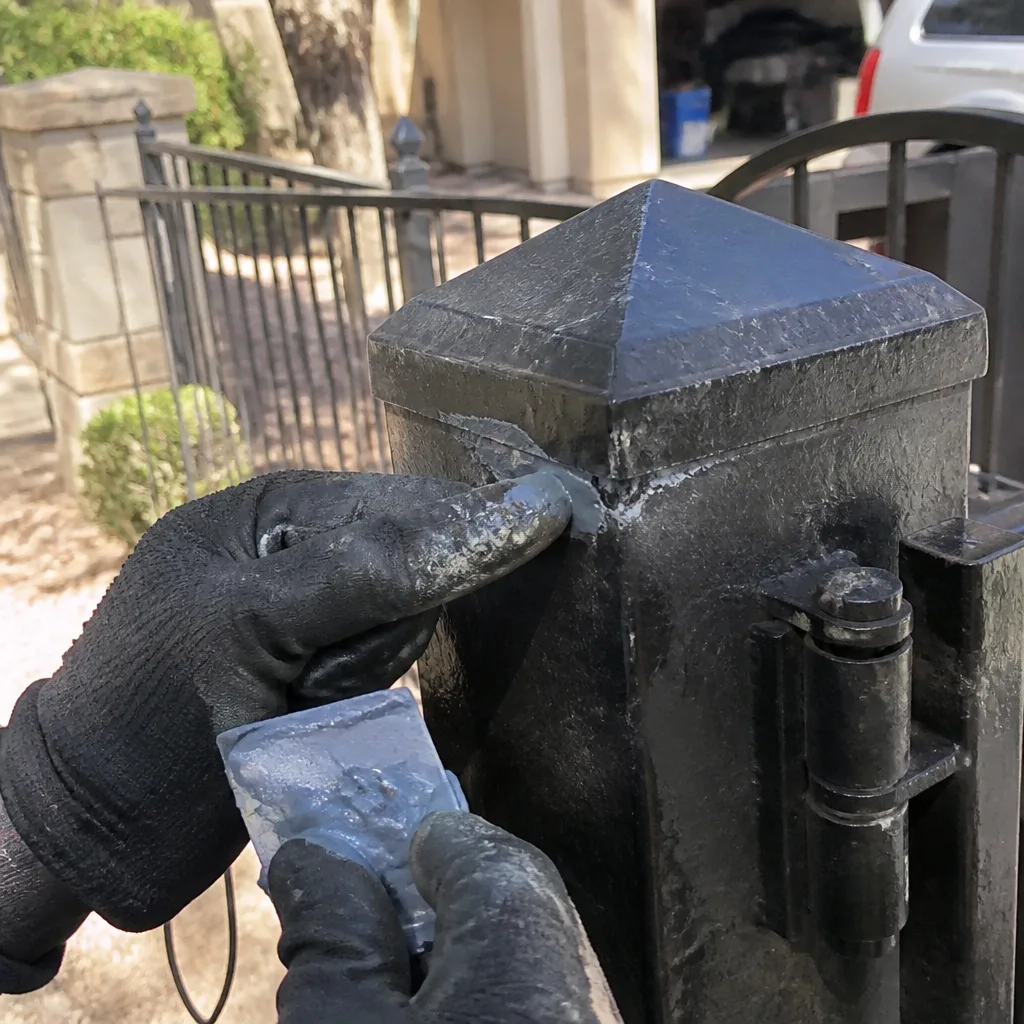
Thermal cycling in Gilbert stresses welds more than in temperate climates. Look for rust staining at weld joints (indicates crack initiation) and hinge pin wear.
Document with photos: one overall, one close-up of each hinge, one of any rust staining. Date the photos. Under Haven Standard Clause 4, we leave a similar photo log on every professional visit - you should maintain your own parallel record.
Quarterly Maintenance Tasks
These tasks require basic tools and 30-45 minutes. Schedule for January, April, July, and October to align with Gilbert’s thermal cycles.
Hardware Torque Verification
Vibration from normal operation and thermal expansion loosen hardware over time. In Gilbert, the daily temperature swing of 30-40°F creates more thermal cycling stress than many climates see seasonally.
- Check all visible fasteners with appropriate driver: hinge bolts, actuator mounting brackets, chain tensioners, track anchors
- Torque to manufacturer specification if known; if unknown, tighten to “snug plus quarter turn” - never over-torque, which strips threads in aluminum components
- Look for zinc plating wear on bolts: white corrosion indicates galvanic reaction, common where aluminum gates meet steel fasteners in humid monsoon conditions
- Replace any fastener that shows thread damage or head rounding - it’s cheaper than extracting a broken bolt
Lubrication with Correct Products
We specify lubricants by gate type and Gilbert conditions:
- Slide gate chain or rack: Dry-film PTFE lubricant (White Lightning Clean Ride or equivalent). Reapply when chain sounds dry, typically every 6-8 weeks in dust season
- Hinge pins and bushings: Silicone spray with PTFE. Avoid lithium grease - it becomes abrasive paste within two weeks in Gilbert dust
- Actuator ball screw or Acme screw: Manufacturer-specified grease only. Incorrect lubricant voids warranty on Viking and Ghost Controls actuators
- Lock mechanism: Graphite powder, never oil - oil attracts dust that jams locks
Control Box Interior Inspection
Power down, open the control box, and photograph the interior before touching anything. This establishes your baseline.
- Look for dust accumulation on circuit boards - a light film is normal; caked dust indicates seal failure
- Check wire insulation for UV cracking, especially on any factory-installed low-voltage wiring that passes through sun-exposed conduit
- Verify terminal screw tightness - thermal cycling loosens these predictably. Tighten with appropriate screwdriver, not fingers
- Look for capacitor bulging or leakage - a bulged top indicates imminent failure
- Close up, photograph again, note any changes from last quarter
Semi-Annual Maintenance Tasks
These tasks require measurement tools and understanding of system parameters. Do them in April (pre-heat) and October (post-heat) for maximum diagnostic value.
Limit-Switch Travel Measurement
This is the skipped step that destroys motors. The limit switch tells the motor when to stop. If it’s set to allow over-travel, the motor stalls against mechanical stops, draws locked-rotor amperage, and overheats. In Gilbert’s summer heat, the motor is already running near thermal limit - over-travel pushes it into failure.
- Locate the limit switch adjustment mechanism - typically a cam or potentiometer on the motor housing, or magnetic limits on the gate itself for some Ghost Controls and Elite models
- Run the gate to full open. Measure the gap between gate and stop post (or mechanical stop) with a tape measure. Should be 1/2 to 1 inch - enough to prevent impact, not so much that the motor runs unnecessarily
- Run to full close. Verify the latch engages cleanly without the motor forcing it - forcing indicates the close limit is set too deep
- Record your measurements: “Open stop gap: 3/4 inch. Close latch engagement: free-fall into receiver, no motor load after contact.”
- Check the limit switch hardware itself: set screws should require deliberate effort to turn, not spin freely. Loose hardware drifts with vibration
Warning reading: Gate contacts stop post before limit switch stops motor; motor strains to pull latch closed; limit hardware spins freely. Normal reading: Clean stop with 1/2-1 inch gap, free latch engagement, tight hardware.
Battery Voltage Under Load
Battery backup systems fail most often in August, when heat has already degraded capacity and a monsoon outage demands full performance.
- With gate on AC power, measure battery voltage at the terminals with a multimeter. Should read 13.2-13.8V for a healthy 12V SLA battery on float charge
- Disconnect AC power at the breaker. Run gate through full cycle
- Measure voltage immediately after cycle. Should be above 12.0V. Below 11.5V indicates replacement needed before next heat season
- Record voltage readings with date. Track degradation trend - a battery that reads 12.4V in April and 12.1V in October will fail in the next summer
Warning reading: Float voltage below 12.8V; loaded voltage below 11.5V; visible case bulging. Normal reading: 13.2-13.8V float, 12.0V+ loaded, flat case sides.
Underground Loop Integrity (If Equipped)
Exit loops and safety loops fail from ground movement, lightning surge, or rodent damage. Testing requires a loop detector with sensitivity adjustment - available for $40-60, or we test this on every professional service call.
- Observe detector LED during vehicle passage: should illuminate consistently at same vehicle position every time
- Note any sensitivity drift: detector requiring higher sensitivity setting than previously indicates loop inductance change, usually from wire damage
- Check loop sealant in asphalt or concrete: cracking allows water intrusion that changes loop characteristics
Annual Maintenance Tasks
These tasks require specialized knowledge or tools. Schedule for January or February, when Gilbert’s mild weather allows extended diagnostic time without heat stress on the technician or the equipment.
Professional Motor Internal Inspection
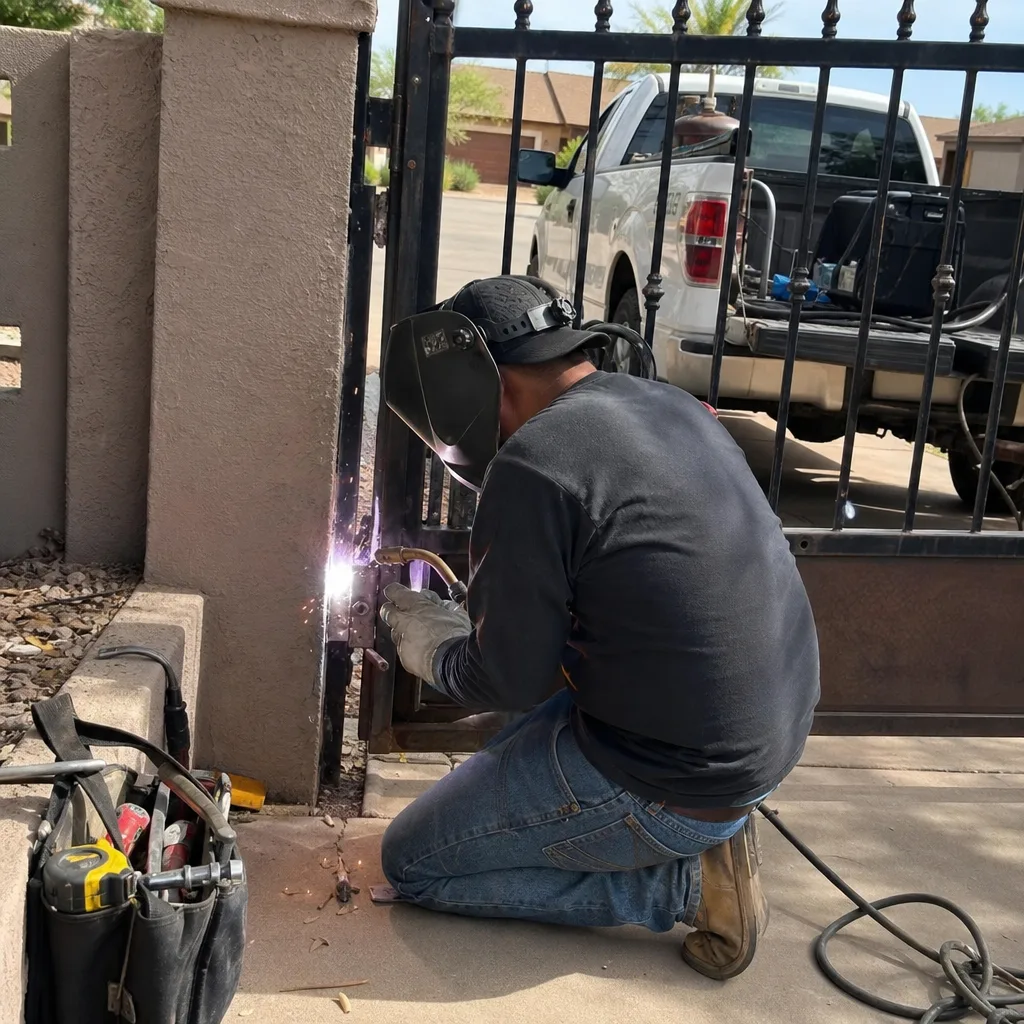
We open motor housings to inspect gear trains, brake assemblies, and capacitor condition. This requires proper torque wrench technique for reassembly - incorrect reassembly causes seal failure and water intrusion. For this reason, we recommend professional service for motor internals.
What we document on every annual inspection:
- Gear wear pattern and backlash measurement
- Brake pad thickness (if equipped - common on Viking and DoorKing commercial-grade operators)
- Capacitor capacitance versus specification
- Motor winding resistance and insulation resistance (megger test)
- Limit switch contact condition and adjustment verification
Under Haven Standard Clause 4, you receive photographs of each finding and a written record of measurements. This becomes your equipment’s medical history - invaluable when diagnosing future issues or evaluating replacement timing.
Weld Ultrasonic or Dye-Penetrant Testing
For ornamental iron gates, annual weld inspection catches crack initiation before propagation. We recommend professional testing for any gate over 8 feet wide or with visible rust staining at joints - both indicators of stress concentration.
Concrete Anchor Pull-Test Verification
Gate posts set in Gilbert’s expansive clay soil move with moisture cycles. Annual plumb-bob check: post should be within 1/4 inch of vertical over 6-foot height. Beyond 1/2 inch, post movement is stressing the gate frame and actuator mounting.
How to Document Your Baseline (The Haven Standard for Homeowners)
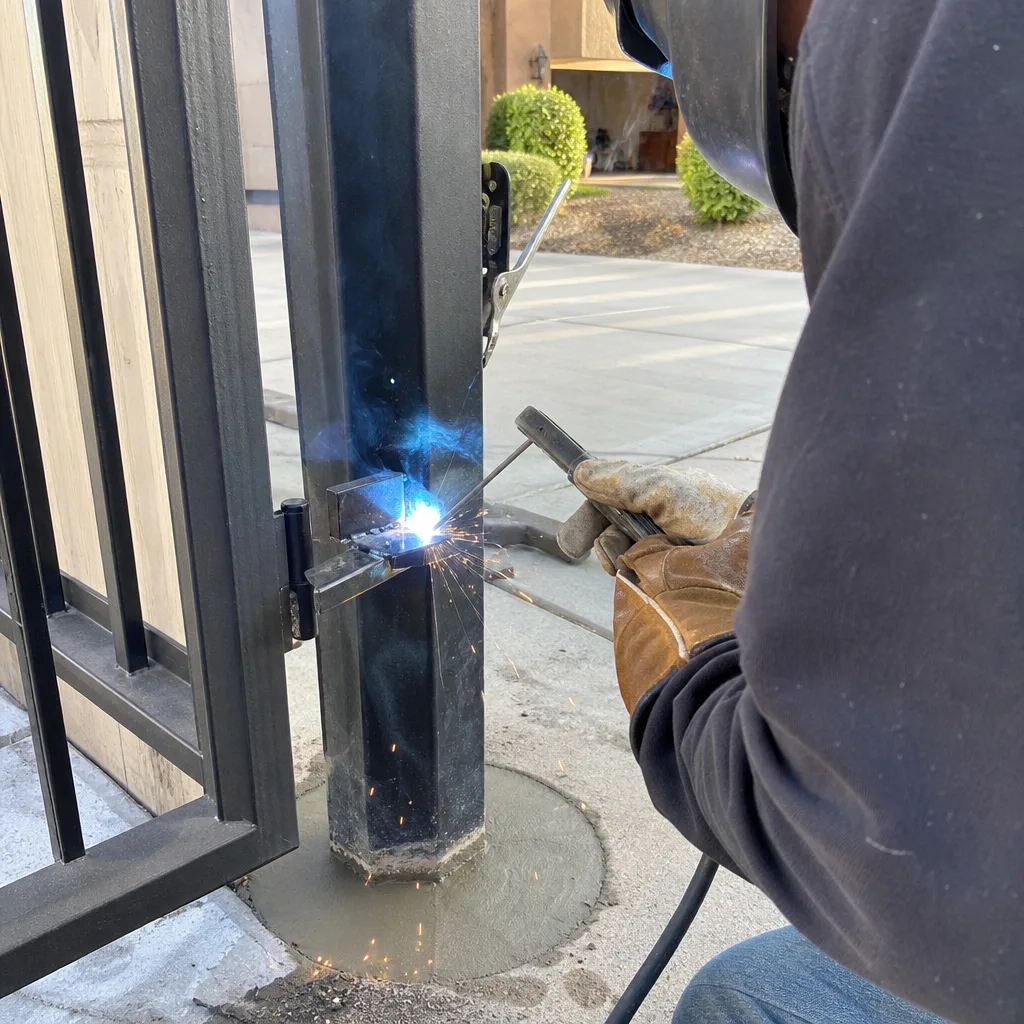
The core principle of our Vance Gate Repair Gilbert home operation is that no technician should have to rediscover what a previous technician already found. Homeowners can apply the same discipline to their own maintenance records.
Your documentation kit:
- Smartphone with date-stamped photos: Photograph every component before and after any work. Include wide shots for location context and close-ups for detail
- Simple spreadsheet or notebook: Date, task, measurement, and “same/changed/failed” status for each check
- Part numbers: Record the exact model and serial number of your operator, remote receiver, and any replaced components. Future technicians need this for compatibility verification
- Wiring diagram: If your installer left one, keep it with the records. If not, photograph the control box interior with wires in place before any disconnection
Specific documentation we recommend for Gilbert conditions:
- Photo-eye alignment record: Photograph the receiver LED and the physical alignment straightedge measurement. Quarterly comparison shows drift trend
- Battery voltage log: Simple table with date, float voltage, loaded voltage, ambient temperature. Trend is more informative than single readings
- Limit-switch setting record: Photograph the cam position or note potentiometer setting. Any unexplained change indicates hardware loosening
- Hardware torque log: Note which fasteners required tightening and by how much. Repeat patterns indicate design stress or material failure
When you call for service, email or text us your documentation. We review it before dispatch, often identifying the issue from your records and arriving with correct parts. This is how Haven Standard Clause 4 (Evidence on every job) works in practice - your evidence plus ours, shared.
Warranty-Safe DIY vs. Warranty-Voiding Work
Gate system warranties vary by manufacturer and component. Understanding the boundary protects your coverage.
Generally safe for homeowner performance (does not void warranty if done correctly):
- Photo-eye cleaning and alignment adjustment
- External debris clearing from track and gate path
- Lubrication with manufacturer-specified products
- Battery replacement with equivalent specification
- Remote control battery replacement and reprogramming
- Visual inspection and documentation
Warranty-voiding if performed by homeowner (requires professional service to maintain coverage):
- Control board replacement or firmware update on most brands
- Motor internal repair or gear train service
- Limit switch replacement or major recalibration on Ghost Controls and some Elite models - these require factory tool authentication
- Weld repair on structural components
- Underground loop replacement or splicing
- Any modification to safety system wiring or sensitivity settings
The critical distinction: warranty coverage for the operator (motor and control system) is typically voided by any internal work not performed by an authorized technician. Warranty coverage for the gate structure (welds, hinges, frame) is typically unaffected by homeowner maintenance but voided by structural modification.
When in doubt, photograph the component label and call us. We can verify warranty status by serial number and tell you whether your intended work preserves or voids coverage. Free second opinion on any question - Haven Standard applies to information, not just pricing.
The Three Consumable Parts on a Replacement Schedule
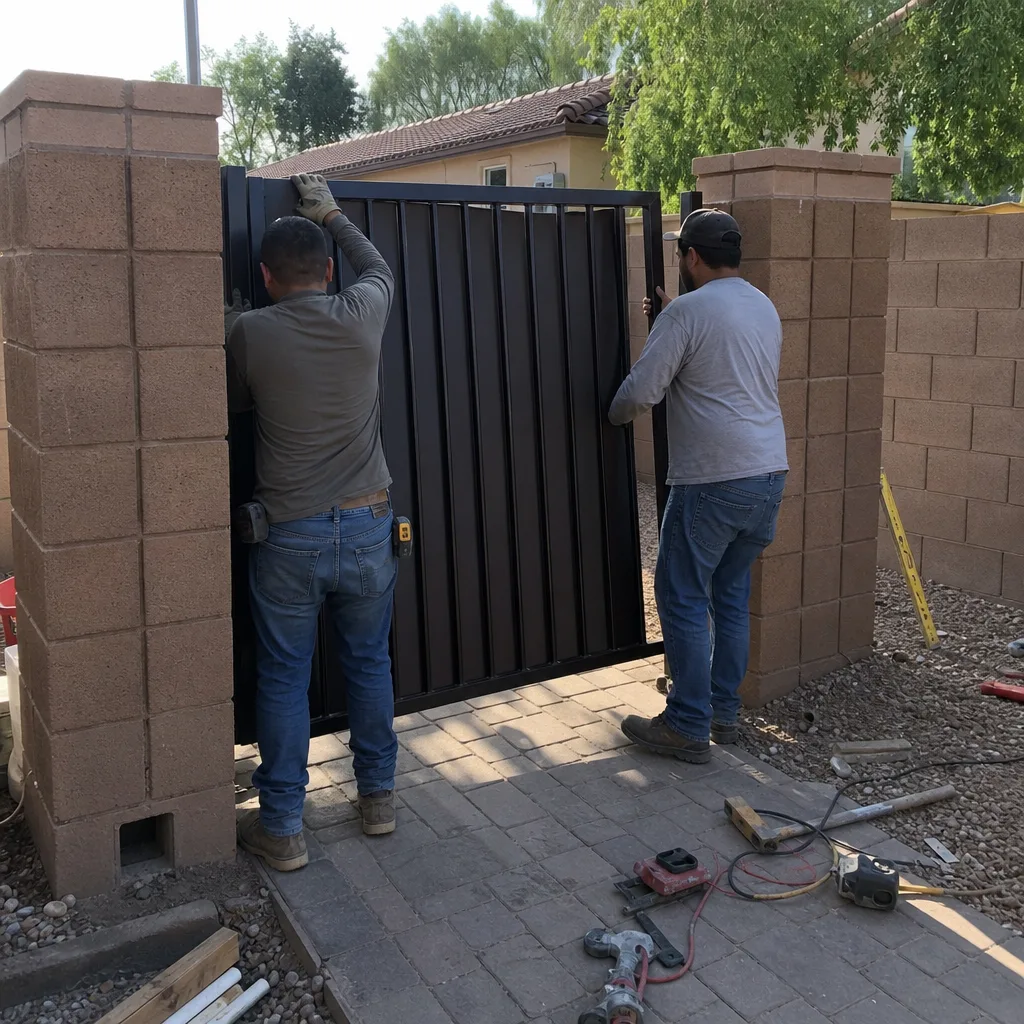
Some parts should not be “checked until broken.” They degrade predictably and fail catastrophically, often damaging adjacent components. We replace these on schedule, not on condition.
1. Battery Backup (Every 3-4 Years in Gilbert, Every 2-3 if Exposed to Direct Sun)
SLA (sealed lead-acid) batteries lose capacity in heat. A battery in a control box mounted on a sun-facing wall in Gilbert degrades faster than the same battery in shaded Mesa or Phoenix installation. We log installation date and replace at 75% of rated life in high-heat exposure.
Cost context: Scheduled battery replacement runs $85-140 including labor. Emergency call for failed battery during outage, with possible control board damage from voltage sag, runs $400-800. The replacement schedule pays for itself on first avoided emergency.
2. Slide Gate Rollers (Every 5-7 Years for Steel, Every 8-10 for Nylon in Clean Installations)
Steel rollers in Gilbert dust conditions develop flat spots and bearing wear. Nylon rollers degrade from UV exposure. Both cause track wear and motor overload when neglected.
Warning signs that schedule is accelerated: visible roller wobble, gate “stuttering” in travel, or metal shavings in track (steel rollers) or chalky residue (UV-degraded nylon). We measure roller runout with dial indicator during annual inspection - beyond 1/16 inch indicates replacement regardless of age.
3. Drive Belt or Chain (Belt: 5-7 Years, Chain: 10-15 Years with Proper Lubrication)
Belt drives (common on LiftMaster and some Linear residential operators) degrade from ozone and heat. Cracking visible on the inner surface indicates replacement due. Chain drives fail from elongation - measure 12 links against specification, replace when elongated beyond 3%.
Incorrect lubricant accelerates both failures. We’ve replaced belts prematurely where owners applied petroleum-based products that attacked the rubber compound. Use only manufacturer-specified products.
Common Mistakes to Avoid
- Using pressure washers on control boxes or photo-eyes. High-pressure water forces moisture past seals that are designed only for rain splash. We’ve replaced control boards in Gilbert homes where “cleaning” caused $600 in damage. Use damp cloth only, low pressure at distance if you must.
- Applying lithium grease to anything in Gilbert. The dust-grease abrasive paste destroys components faster than no lubrication at all. We’ve found bronze bushings worn to oval shapes in 18 months from this single error. Use dry-film products exclusively.
- Ignoring the “small” limit-switch drift. A gate that still opens and closes but bumps the stop slightly harder each month is accumulating motor damage. By the time the motor fails, the homeowner has forgotten the subtle change. Measure quarterly, act on any measurable drift.
- Testing safety systems by standing in the gate path. Photo-eyes should be tested with a rigid object (broom handle, cardboard box), not your body. Mechanical edges should be tested with a soft object that simulates limb compliance. We’ve responded to injuries from “it always stops for me” confidence.
- Skipping documentation because “I’ll remember.” Memory is unreliable; thermal expansion changes are gradual; your next technician needs the baseline. The 10 minutes to photograph and record saves hours of diagnostic time and prevents repeat discoveries.
- Assuming all brands adjust the same way. Viking limit cams require different technique than Ghost Controls magnetic limits than DoorKing potentiometer settings. Manufacturer manuals are specific for reason. Incorrect adjustment on some brands requires factory reset tool to recover.
- Waiting for complete failure before calling. Intermittent issues - occasional non-response, slight travel variation, remote requiring multiple presses - are early warnings. They cost less to fix than emergency replacement, and they’re documented more thoroughly when the system is still functional.
When to Call a Professional
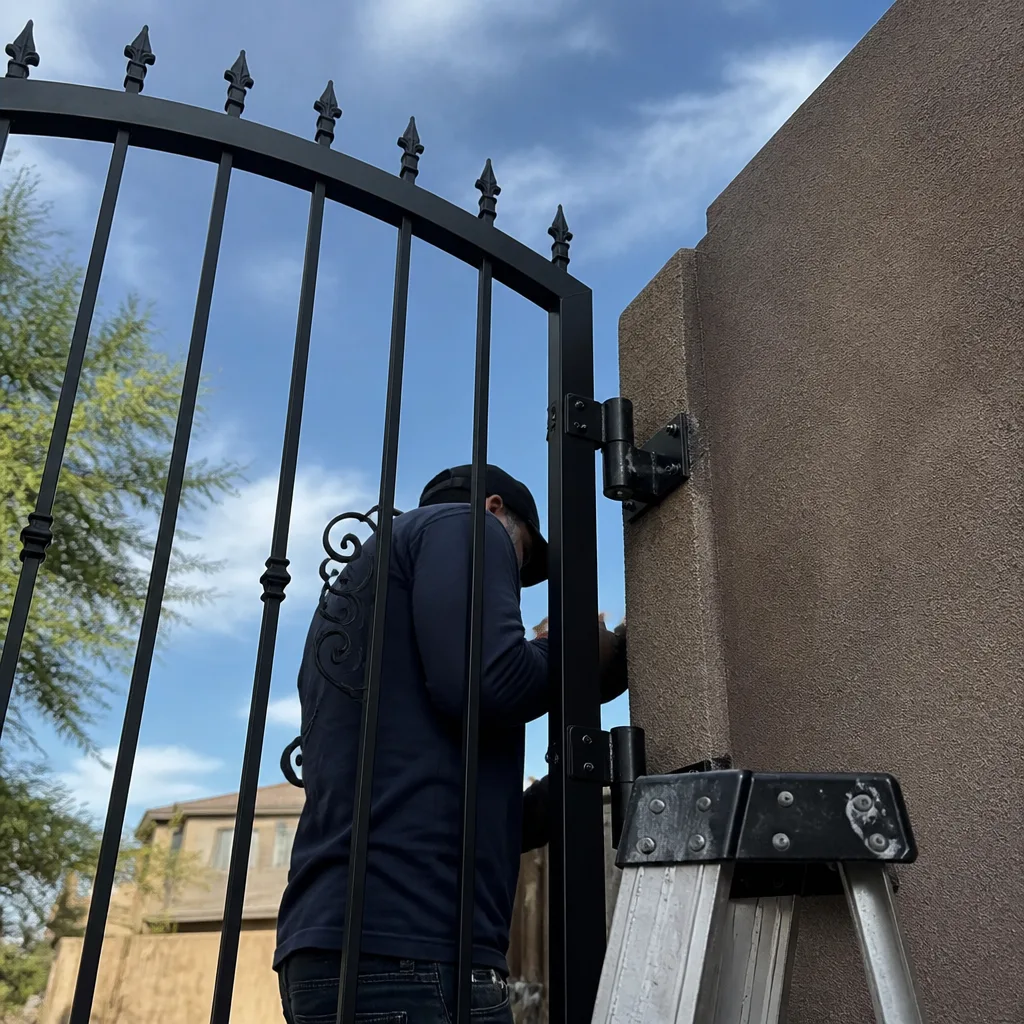
Call for professional service when you encounter any of the following: motor hums but gate doesn’t move (mechanical or electrical failure beyond DIY scope); visible weld cracks or gate frame deformation; control box shows burned smell, scorched components, or repeated breaker trips; limit switch hardware is damaged or adjustment mechanism stripped; underground loop shows erratic detection or no detection; any safety system test fails; or you’re uncomfortable with electrical measurement or working near high-tension components.
We also recommend professional annual inspection even if your monthly and quarterly checks show normal readings. Our technicians have thermal cameras to detect motor hotspot patterns, milliohm meters to find developing ground faults, and experience with nine automation brands that informs pattern recognition no checklist can replace.
Vance Gate Repair Gilbert offers free estimates in Gilbert - call (520) 482-3109. Under Haven Standard Clause 1, you’ll receive a written scope and price before any work starts. Under Clause 4, every visit includes a documented photo record at no additional charge. And every repair is covered by our 365-Day Done Right Promise: if it’s not right, we make it right, no argument, no fee.
Frequently Asked Questions
Annual professional maintenance for a typical residential gate in Gilbert runs $180-320, depending on gate type (swing vs. slide), access to components, and whether underground loops or multiple operators are involved. This includes full diagnostic, limit-switch verification with measurement, hardware torque check, lubrication with correct products, battery load test, and documented photo record. Repairs or parts replacement are quoted separately with written price before work starts. Call (520) 482-3109 for an exact quote - estimates are free.
Homeowners can safely perform the monthly and quarterly tasks in this checklist, which prevent most emergency failures. Annual motor internal inspection, weld testing, and any control system work should be professional to maintain warranty coverage and ensure safety system integrity. The cost of professional annual service is typically recovered by extended component life and avoided emergency calls. We’ve documented cases where $200 annual maintenance prevented $1,200 motor replacement at year five.
High ambient temperature reduces motor winding insulation life by approximately half for every 10°C above rated temperature. A motor rated for 20,000 hours at 40°C operates roughly 5,000 hours at 60°C ambient - and Gilbert summer ambient plus motor self-heating routinely reaches this range. Capacitors degrade faster, grease separates, and control board solder joints experience more thermal cycling stress. This is why we emphasize limit-switch accuracy: any over-travel that causes stall adds 300-500% to normal motor heating.
First, power down at the disconnect - never operate a gate that has taken impact or shows visible damage. Photograph all damage before touching anything for insurance and service documentation. Check for: debris in track or path, bent gate members, loose or displaced hardware, water in control box, and erratic behavior on first test cycle. Even if the gate appears functional, thermal damage to motor windings from stall against debris may not show immediately. We recommend professional inspection after any significant impact or flooding - the 365-Day Done Right Promise covers our work, but not damage from delayed reporting of storm effects.
Proper homeowner maintenance - cleaning, lubrication with specified products, visual inspection, and battery replacement with equivalent specification - does not void warranty. Warranty is voided by: opening motor housings, replacing control boards, modifying safety systems, using non-specified parts, or damage from improper maintenance (pressure washing, incorrect lubricant, over-torquing). When in doubt, photograph the component label and call us - we’ll verify warranty status by serial number at no charge.
Symptom patterns distinguish failure from misadjustment: gradual slowing over months suggests motor degradation or mechanical binding; sudden speed change or erratic stopping suggests limit-switch or control issue; increased noise with same speed suggests mechanical wear; and intermittent operation (works sometimes, not others) typically indicates electrical connection or control board problem, not motor failure. Accurate diagnosis requires measurement - motor current draw, limit-switch position, and supply voltage under load. We perform this diagnostic systematically and show you the readings under Haven Standard documentation.
The Bottom Line
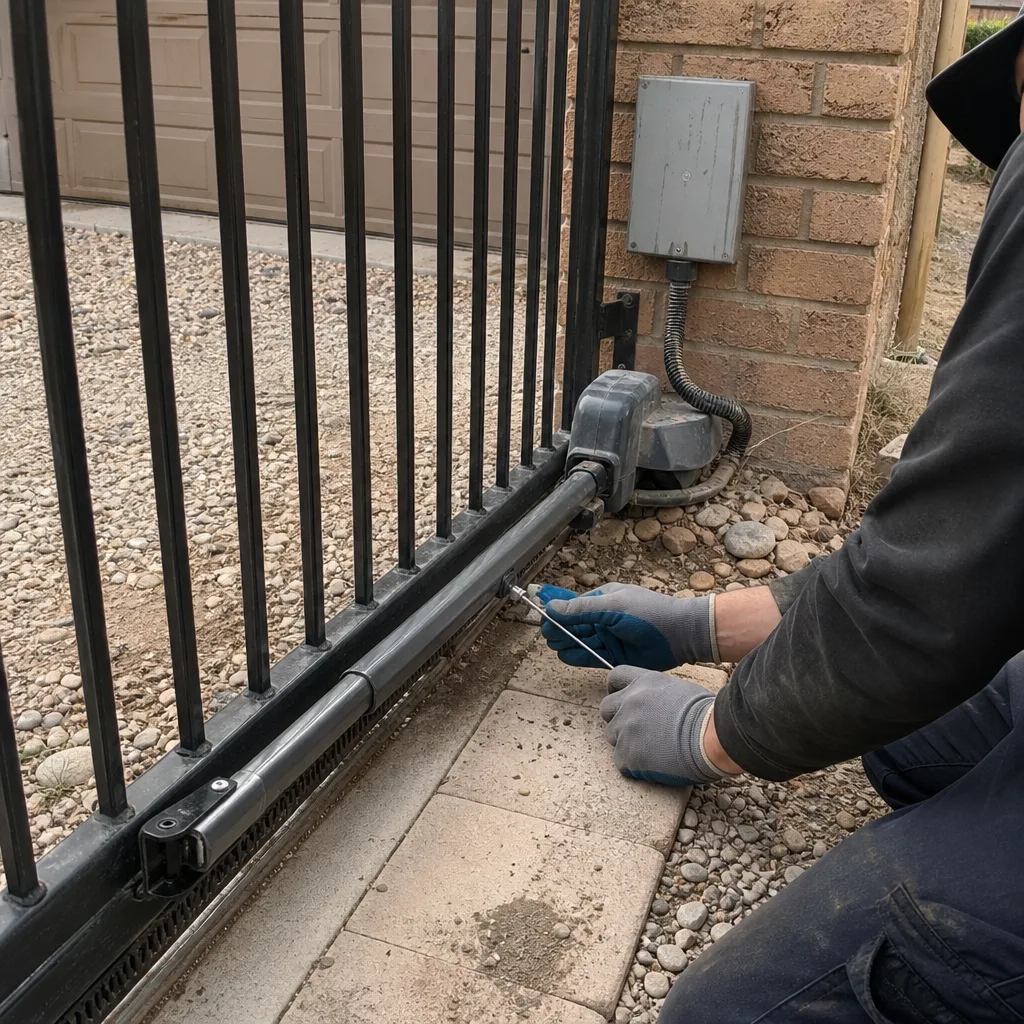
Gate maintenance in Gilbert is not a generic checklist with a city name swapped in. The UV exposure, dust infiltration, and thermal cycling here create specific failure modes that require specific countermeasures: dry-film lubrication, quarterly limit-switch measurement, battery replacement before summer stress, and documentation that lets the next technician build on what’s already known. Follow the monthly, quarterly, semi-annual, and annual schedule in this guide, respect the boundary between warranty-safe DIY and professional work, and replace consumable parts on schedule rather than on failure. The 15 minutes monthly and the professional annual inspection together prevent the emergency calls that cost five to ten times as much and always seem to happen when you’re leaving for work.
Written by Adrian Vance, Owner at Vance Gate Repair Gilbert, serving Gilbert since 2014.