
Last updated September 22, 2026
Free on-site gate assessment - hinges, posts, and your LiftMaster or Nice gate operator checked before anything is quoted
The assessment is free and the quote is the invoice.

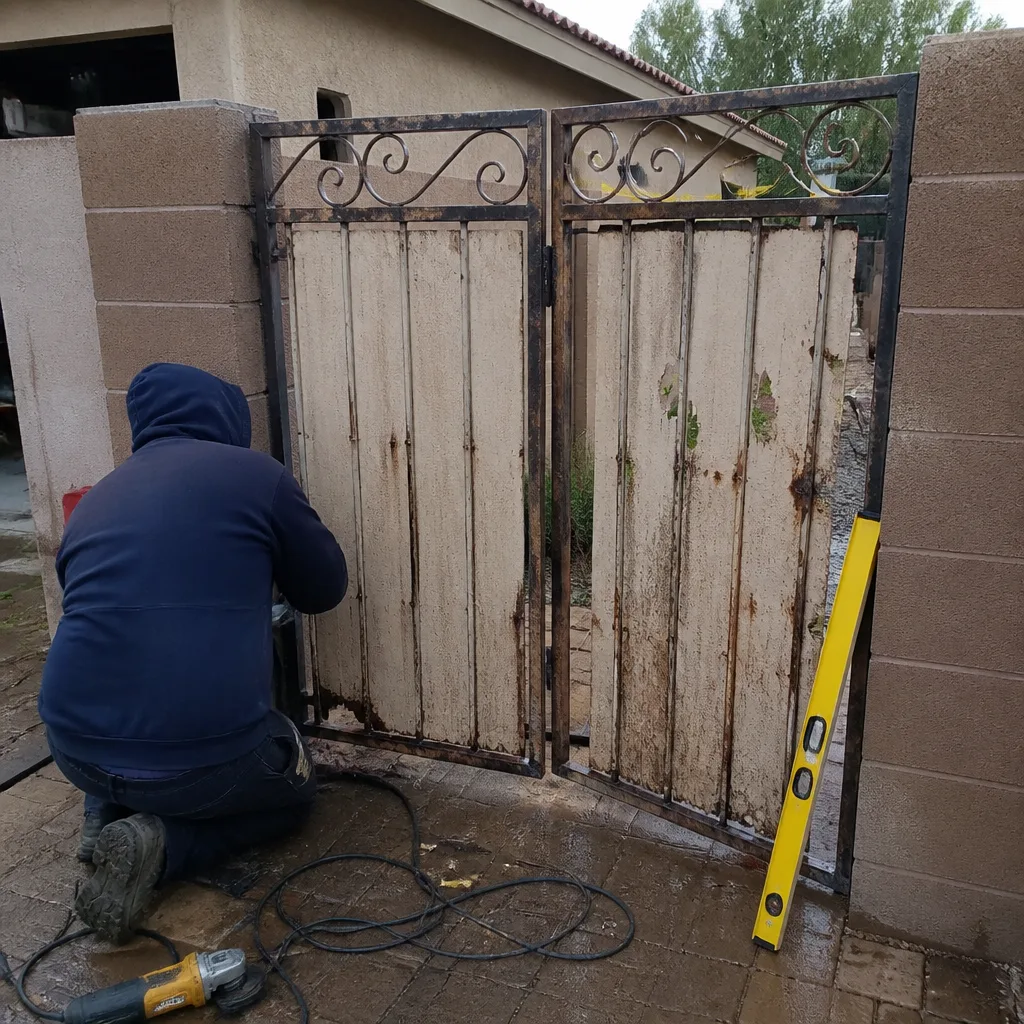 Before
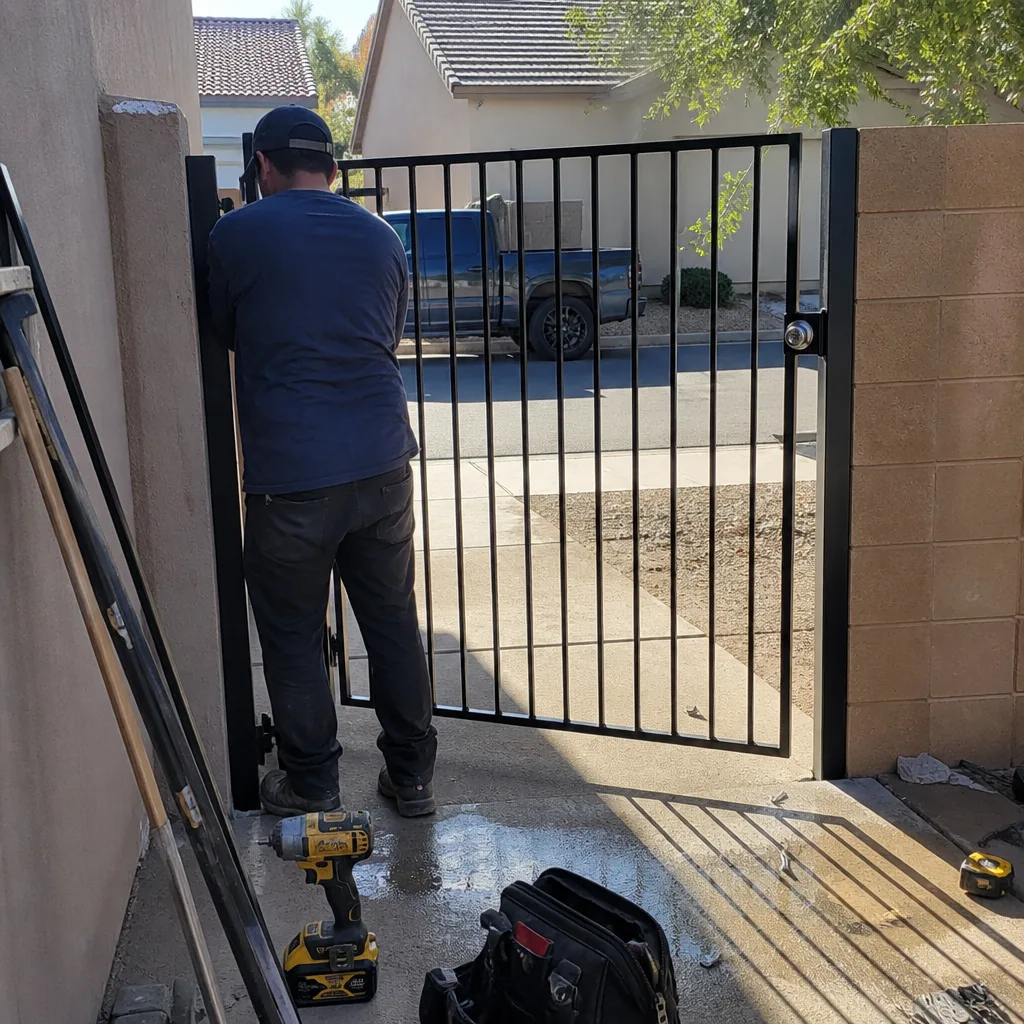 After
After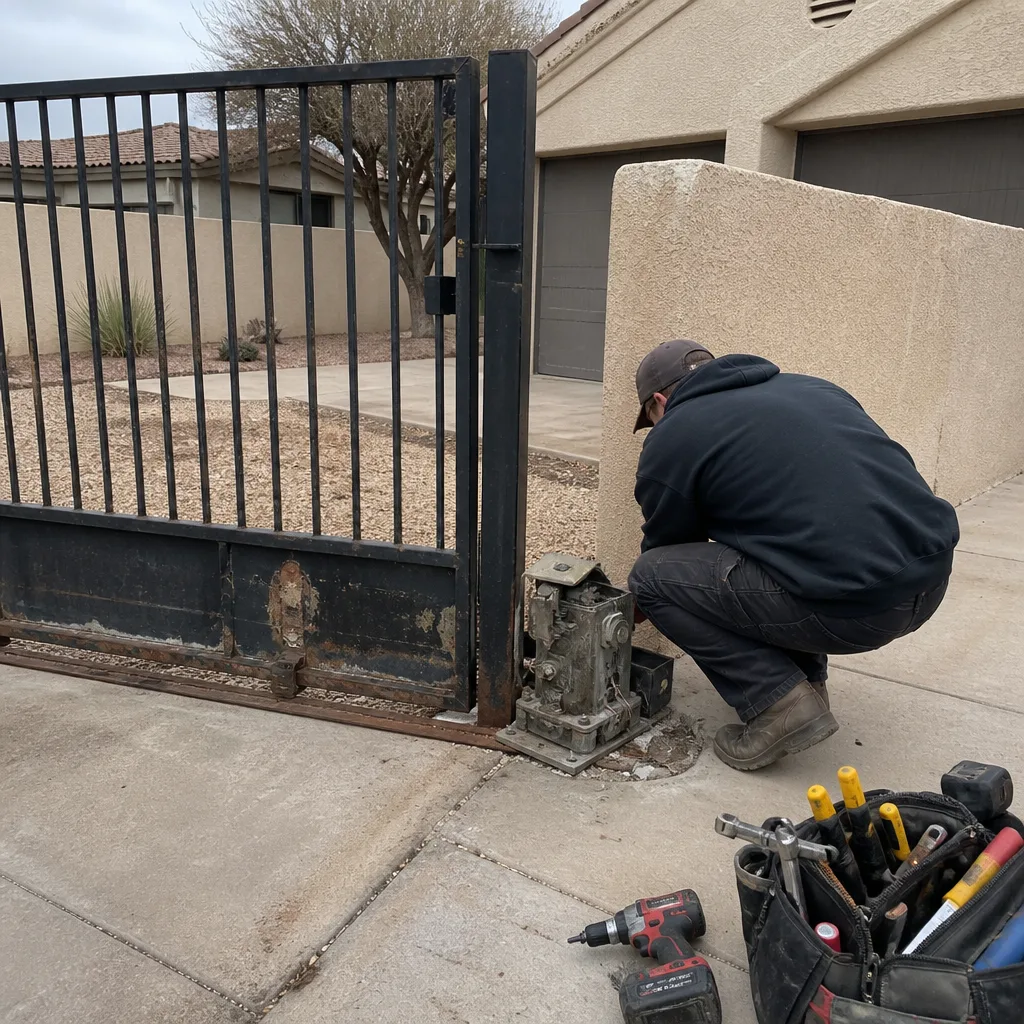 Before
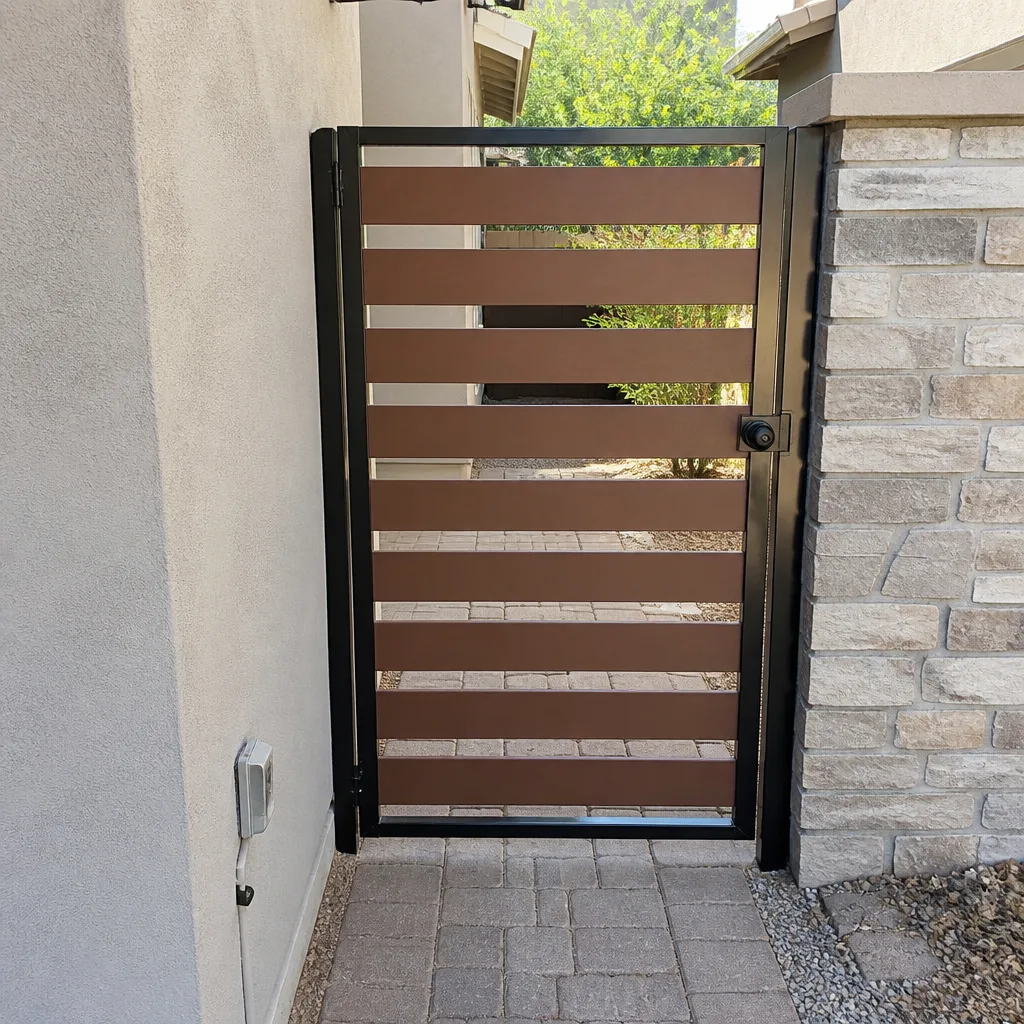 After
After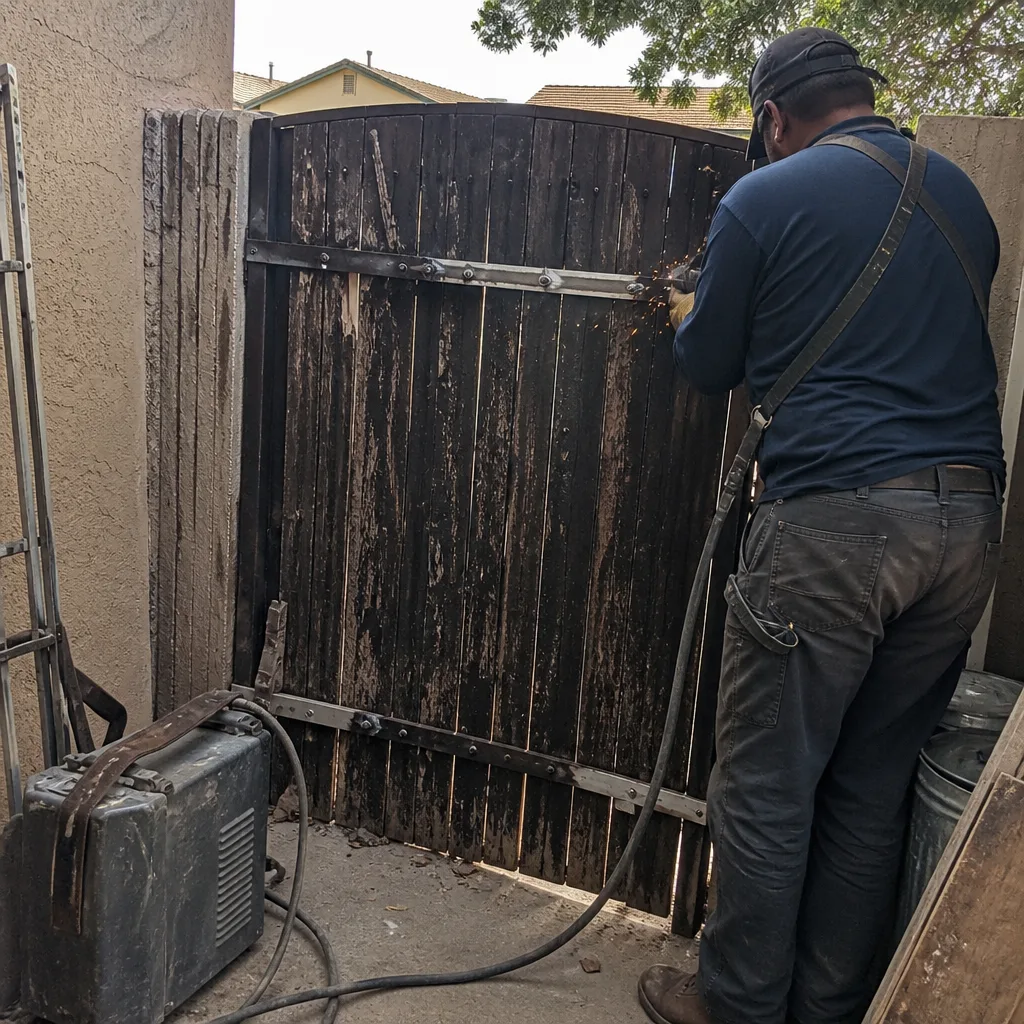 Before
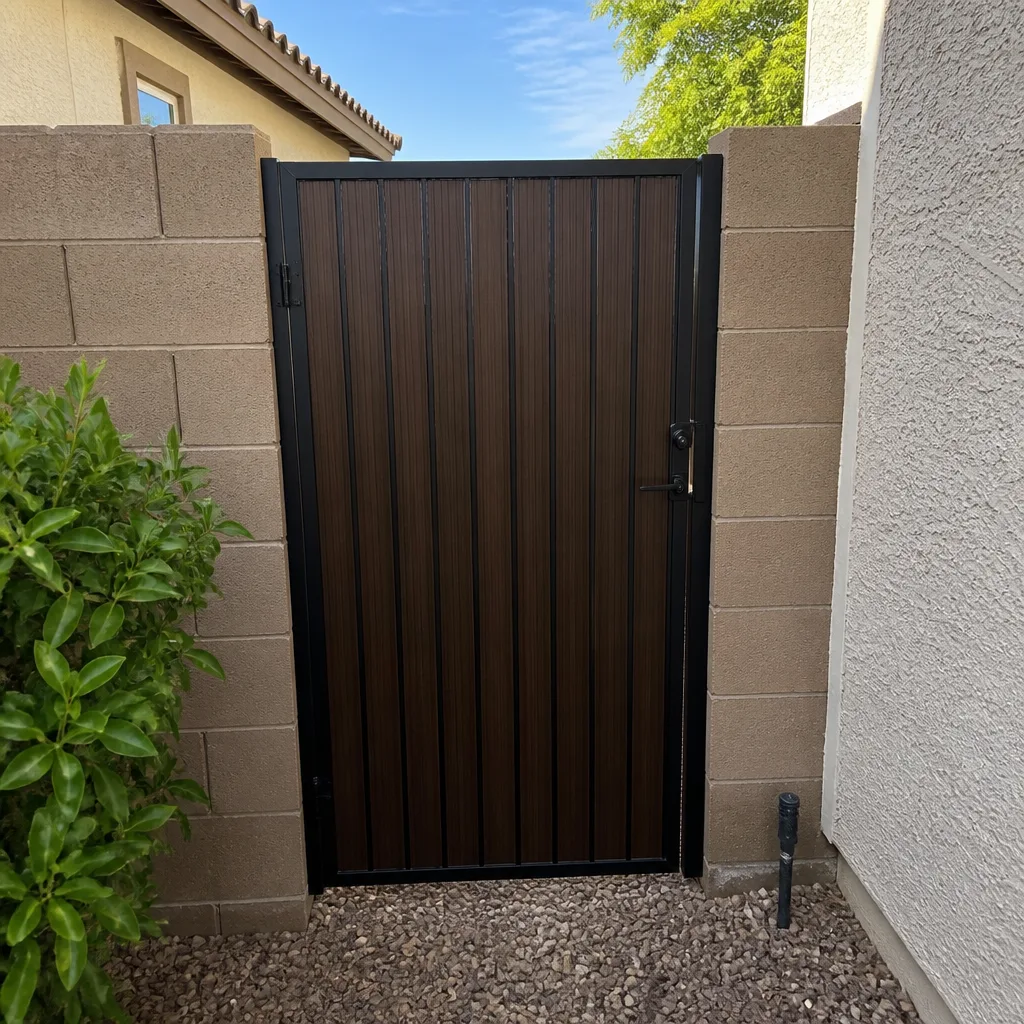 After
AfterGate Repair Warning Signs: A Gilbert Homeowner’s Reference Guide
A gate that hesitates for two seconds before moving isn’t “acting weird.” It’s a motor drawing excess current against mechanical resistance, and that specific symptom points to one of four documented causes with repair costs that range from $140 to $1,200 depending on what’s failing. Most gate failures in Gilbert give 30 to 90 days of warning before they become emergencies, but the signals are easy to dismiss: a slightly longer open cycle, a grinding sound that only appears in the morning, a remote that needs two presses. This guide translates those early symptoms into specific diagnoses so you can name the problem accurately rather than describing vague behavior to a technician, and complements our How to Hire a Gate Repair Contractor in Gilbert: A Step-by-Step Guide if you need professional help. You’ll learn which warning signs demand immediate attention, how Gilbert’s summer heat compresses failure timelines, and what to photograph and measure before anyone arrives.
Quick Answer
Gate repair warning signs fall into two categories: operator-side symptoms (hesitation, grinding, partial travel, remote range loss) and structural symptoms (post lean, hinge sag, track misalignment). In Gilbert’s climate, heat-accelerated failures often compress a 60-day warning window to 14-21 days during summer. Immediate safety risks include gates that reverse unpredictably, slam closed, or show visible post movement; these require same-day professional inspection. Most other symptoms allow a scheduled repair window of 3-7 days.
Table of Contents
- Symptom-to-Diagnosis: What Your Gate Is Actually Telling You
- How Gilbert’s Heat Accelerates Failure Timelines
- Operator Warning Signs vs. Structural Warning Signs
- Safety-Risk Symptoms That Demand Immediate Response
- Symptoms That Allow a Scheduled Repair Window
- What to Photograph and Measure Before the Technician Arrives
- Typical Repair Costs in Gilbert by Symptom
- Maintenance That Prevents Emergency Calls
 Before
 After
AfterSymptom-to-Diagnosis: What Your Gate Is Actually Telling You
We’ve documented 22,000+ gate repairs since 2014, and the pattern is consistent: homeowners who describe symptoms precisely get faster, more accurate repairs. The technician spends less time diagnosing and more time fixing. Below is a symptom-to-diagnosis mapping for the most common observable behaviors we see in Gilbert.
Hesitation Before Movement (1-4 Second Delay)
When a gate sits still for one to four seconds after receiving a command, the motor is drawing elevated amperage against resistance it shouldn’t be fighting. The four most common causes:
- Worn drive gear or belt. The motor spins but the drivetrain slips internally before engaging. On Linear and Viking operators, we see this at the 6-10 year mark in Gilbert’s heat. Repair: gear or belt replacement, $180-$340.
- Binding hinge or roller. The gate frame is physically stuck until the motor overcomes static friction. Common after monsoon season when grit packs into hinge barrels. Repair: hinge service or replacement, $140-$280.
- Degraded start capacitor. The motor can’t generate initial torque. This produces a humming sound during the hesitation period. Repair: capacitor replacement, $160-$220.
- Low voltage at the operator. Caused by undersized wire runs, corroded connections, or transformer degradation. We measure this with a multimeter at the operator terminals: anything below 90% of rated voltage indicates a supply problem. Repair: wire or transformer replacement, $200-$480 depending on run length.
In our Gilbert records, cause #2 (binding hinge) spikes every September after dust storms and summer humidity cycles. If your hesitation started in late August or early September, mention that timing to the technician.
Grinding or Gritty Sound During Travel
Grinding has three distinct mechanical sources, and the sound’s location tells you which:
- Grinding from the operator housing: Worm gear or drive sprocket losing teeth. The sound is metallic, rhythmic, and matches gate speed. On Ghost Controls operators, this often precedes total gear failure by 20-40 cycles.
- Grinding from the gate frame: Metal-on-metal contact at a hinge, roller, or track point. The sound changes with gate position. Common on slide gates in Gilbert’s Agritopia and Power Ranch neighborhoods where wind-blown grit accelerates wear.
- Grinding from the motor itself: Bearing failure. The sound is continuous, not rhythmic, and may include a high-frequency whine. This motor needs replacement, not repair.
Partial Travel (Stops Before Fully Open or Closed)
A gate that stops short has either lost its position reference or is hitting a physical obstruction. The diagnostic split is simple: does it stop in the same place every time, or does the stop point vary?
Same stop point every time: The limit switch or encoder has drifted or failed. The operator thinks it has reached its programmed endpoint. On DoorKing and Elite systems, we see this after power events common during Gilbert’s summer monsoons. Resetting limits takes 15-30 minutes with the right programmer; guessing takes hours and risks over-travel damage.
Variable stop point: Mechanical resistance is triggering the obstruction sensor (the photo-eye or the motor’s current-sense circuit). The gate stops where resistance exceeds the threshold. This is the more serious scenario: something is physically wrong, and the safety system is doing its job.
Remote Range Reduction
When a remote that worked from 50 feet now requires 20 feet or direct line-of-sight, the problem is rarely the remote battery. More common causes:
- Antenna degradation or displacement. The operator’s receiver antenna has corroded, been damaged by landscapers, or shifted inside the housing. We see this on Mighty Mule operators where the antenna exits through a rubber grommet that hardens in heat.
- RF interference. New nearby devices on 310, 315, or 390 MHz (common gate remote frequencies). In Gilbert’s denser neighborhoods like the Islands or Finley Farms, new construction or neighbor equipment can introduce interference.
- Receiver sensitivity decline. The receiver board itself is failing, often from heat-related capacitor degradation.
Test: stand at the operator with the remote. If range is still poor at 10 feet, it’s not an antenna issue; it’s the receiver or remote itself.
How Gilbert’s Heat Accelerates Failure Timelines
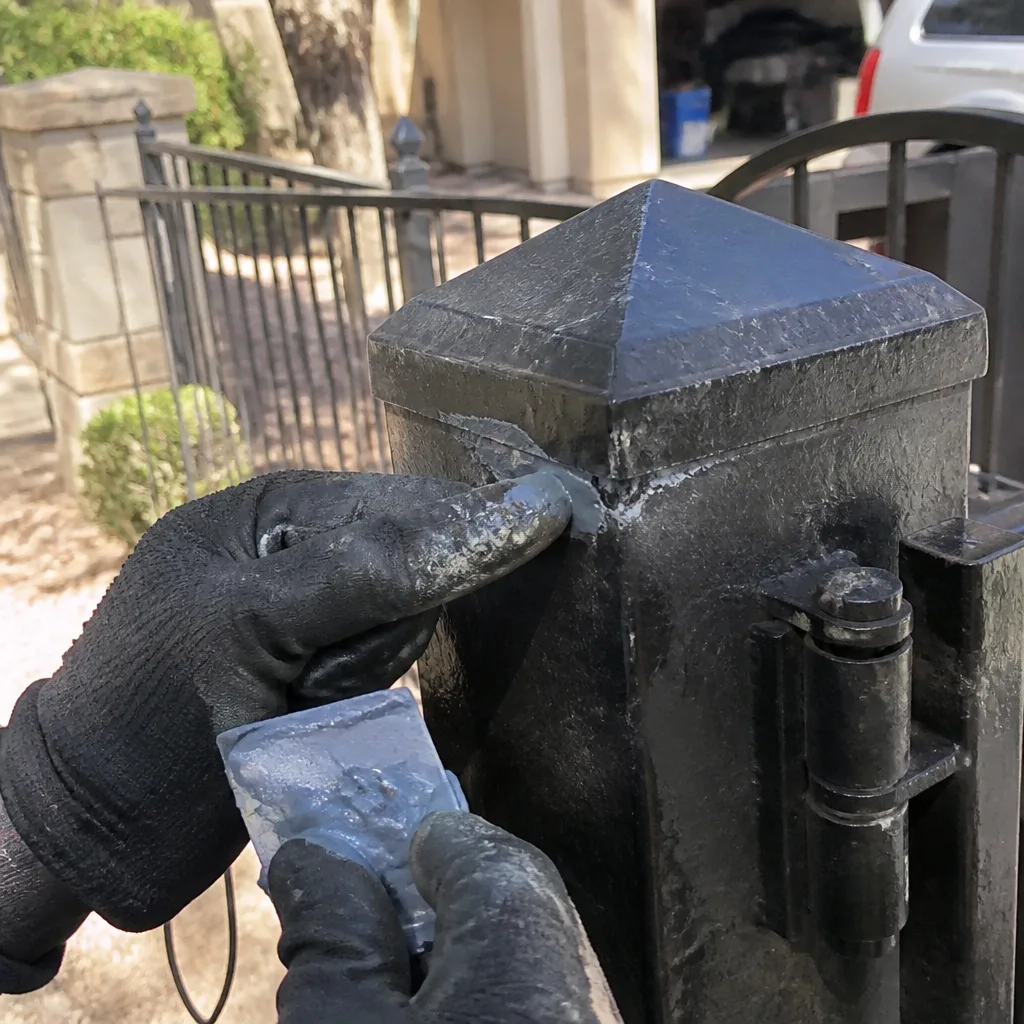
Gate operators are rated for ambient temperatures, and most residential models are tested to 140°F internal temperature. Gilbert’s summer ambient highs reach 112-118°F, and operator housings in direct sun can exceed 160°F. This isn’t a minor stress; it’s a fundamental acceleration of every wear mechanism.
Here’s how the timeline compression works in practice:
| Component | Moderate Climate Warning Window | Gilbert Summer Warning Window | Failure Mode |
|---|---|---|---|
| Drive belt (rubber compound) | 60-90 days of visible cracking | 14-21 days from first crack to failure | Slip, then snap; gate stops mid-travel |
| Start capacitor | 90-120 days of weak starts | 30-45 days; electrolyte dries faster | Motor hums, won’t turn |
| Limit switch/encoder | Stable until failure | Heat cycling causes drift | Partial travel, inconsistent stop points |
| Photo-eye lens | Gradual film buildup | UV crazing and dust fusion | False obstruction detection, gate won’t close |
| Control board capacitors | 5-7 year typical life | 3-4 years in unshaded housing | Erratic behavior, no power, or safety circuit failure |
The practical implication: a symptom you notice in late May could become a full failure by mid-June. We see this spike in emergency calls every year during the first sustained heat wave, typically the third week of June in Gilbert. The homeowners who call in early June for “a slight hesitation” avoid the July emergency premium.
Shade matters enormously. An operator mounted on the north side of a masonry wall lasts roughly 40% longer than the same unit in direct south exposure. If your operator housing is too hot to touch comfortably, it’s too hot for long component life. Simple mitigation: a vented operator cover or relocating the unit to shaded mounting. We document housing temperature on every Gilbert visit and note it in the photo record.
Operator Warning Signs vs. Structural Warning Signs
This distinction determines whether you’re facing a $200 service call or a $2,000+ rebuild. Operator symptoms involve the motor, controls, and drivetrain. Structural symptoms involve the gate frame, posts, hinges, and track. The two categories overlap in their visible presentation, so here’s how to separate them.
Operator-Only Symptoms
- Gate moves smoothly when operated manually (disconnected from operator)
- Noise originates specifically from the operator housing
- Symptoms are consistent regardless of temperature or time of day
- Gate weight and balance feel neutral when pushed by hand
Structural Symptoms
- Gate drags, binds, or requires noticeable force to move manually
- Visible post lean or gate frame twist
- Hinge gap changes as gate moves through its arc
- Slide gate roller jumps track or binds at specific points
- Gate weight feels heavy or uneven when pushed by hand
A gate post leaning 2 degrees is a bigger emergency than a worn drive gear. Here’s why: the structural problem worsens nonlinearly. A 2-degree lean becomes 4 degrees faster than it became 2, because the gate’s weight is now applying eccentric load to the footing. We’ve replaced posts in Gilbert’s older neighborhoods, particularly around downtown and the historic district, where original footings were poured to 24-inch depth instead of the current 36-inch standard. A leaning post in sandy soil, common in parts of east Gilbert, can fail completely within a single monsoon season.
The operator can mask structural problems for months. A powerful motor will push a binding gate until the motor itself fails. When we arrive, the homeowner expects an operator replacement, but the root cause is a $1,800 post and footing rebuild. Under Haven Standard Clause 1, we quote both: the operator repair if that’s all you want, and the structural correction if you want the problem solved. Most homeowners choose the structural fix once they see the photo evidence of post movement.
Safety-Risk Symptoms That Demand Immediate Response
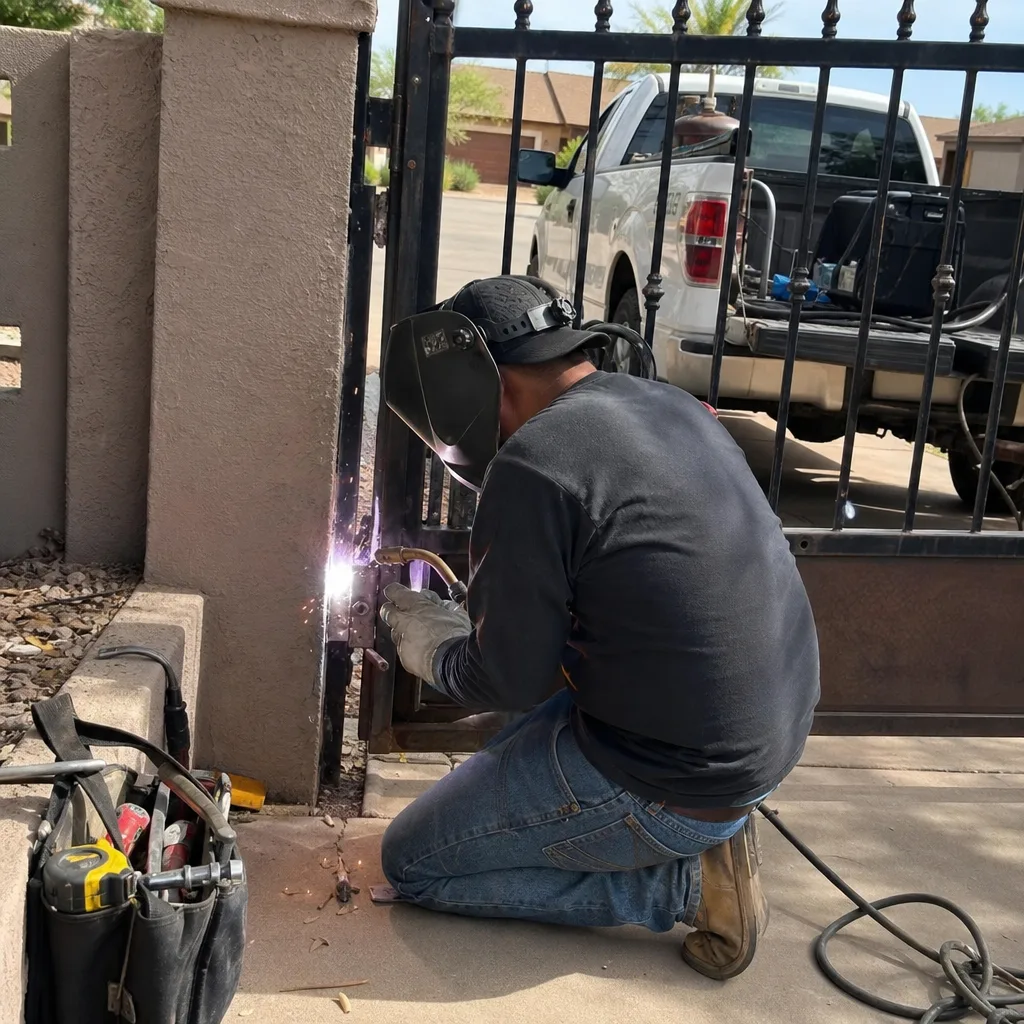
Some warning signs indicate active danger to people, vehicles, or property. These override cost considerations and scheduling convenience.
Immediate Safety Risks (Same-Day Inspection Required)
- Gate reverses unpredictably or without obstruction. This indicates a failed or bypassed safety circuit. The gate could close on a person or vehicle without warning. Disconnect power and use manual release until inspected.
- Gate slams closed with force instead of controlled deceleration. The limit switch or hydraulic/closing force setting has failed. Impact force on a typical residential swing gate can exceed 400 pounds at the leading edge.
- Visible post movement or ground cracking around footing. The gate’s structural support is compromised. A complete collapse is possible, especially during wind events or if the gate is operated while the post is failing.
- Exposed wiring or water in operator housing. Electrocution risk, especially with 120V operators. Gilbert’s summer storms can flood low-mounted housings or damage conduit seals.
- Gate detaches from operator arm while under power. The gate is now an uncontrolled mass. Do not operate; the manual release may also be compromised.
For any of these, we recommend disconnecting power at the breaker (not just the remote) and using the manual release to secure the gate in a fixed position. Our live answering is available 24/7 to assess urgency and dispatch if needed: (520) 482-3109.
High-Risk Contexts in Gilbert
Pool gates and gates separating pedestrian areas from vehicle areas carry elevated liability exposure. Arizona’s attractive nuisance doctrine and Gilbert’s pool barrier code (adopted from the 2018 ICC standards) require self-closing, self-latching gates with specific height and gap requirements. A pool gate that reverses unpredictably or fails to latch is both a safety emergency and a code violation. We document code compliance on every pool gate repair and flag deviations even when they’re outside the repair scope.
Symptoms That Allow a Scheduled Repair Window
Not every warning sign requires emergency dispatch. These symptoms typically allow 3-7 day scheduling without significant risk escalation:
- Gradual remote range reduction (described above) - inconvenient but not dangerous
- Audible grinding that has been stable for weeks - wear is occurring, but the component has residual life
- Slight hesitation (under 2 seconds) with consistent timing - early-stage, predictable failure
- Cosmetic rust on hinge or track - surface oxidation, not yet structural
- Intermittent photo-eye misalignment - clean and realign, schedule full inspection if recurs
The key discriminator is consistency. A symptom that appears randomly, varies in severity, or is worsening week-to-week needs faster attention than a stable, predictable behavior. When you call, describe the pattern: “Every morning for three weeks, 2-second hesitation, then normal operation all day” gives us more useful information than “it’s been acting weird.”
What to Photograph and Measure Before the Technician Arrives
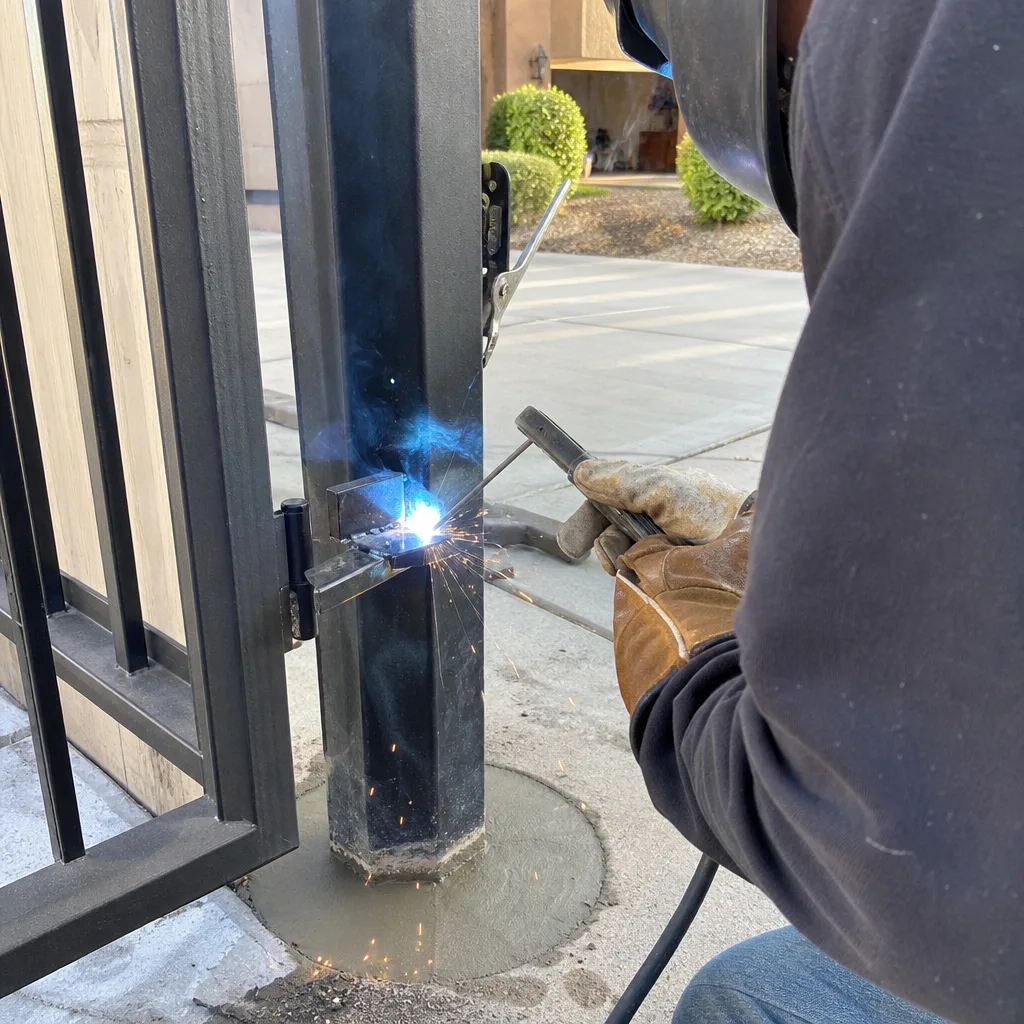
Your description becomes evidence when it includes specific measurements and images. This reduces diagnostic time, eliminates miscommunication, and supports your warranty claim if the problem recurs. Here’s what to capture:
Photograph These Six Items
- Operator nameplate. The label with model number, serial number, and date code. Usually inside the housing cover. This tells us parts availability and known failure patterns.
- Overall gate and post from 10 feet back. Shows alignment, lean, and surrounding grade. Include any visible cracking or erosion.
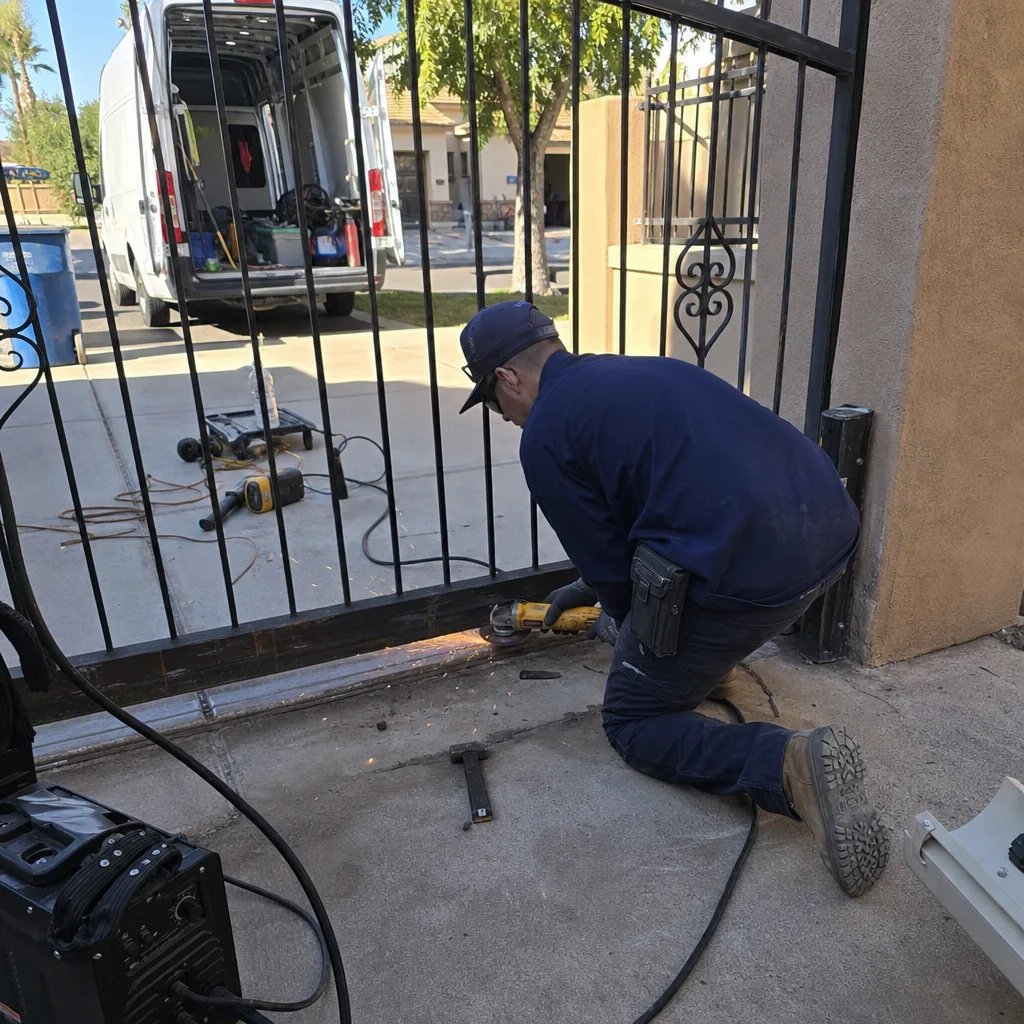
- Hinge or roller at closest point of contact. Shows wear pattern, gap, and any metal transfer (indicates binding).
- Photo-eye alignment and lens condition. Both sender and receiver units, including any vegetation or debris in the beam path.
- Control board or terminal strip. Shows wire condition, connection quality, and any visible component damage. Only if safe to access with power off.
- Ground around post footing. Any cracking, heaving, or water pooling indicates footing stress.
Measure and Record These Three Values
- Gate travel time. Use a stopwatch: from full stop at open to full stop at closed. Compare to your memory of normal speed; 20% slower indicates developing resistance.
- Post lean. Hold a level against the post and measure the gap at top and bottom, or use a smartphone level app. Any reading over 1 degree warrants discussion.
- Hinge gap. Measure the space between gate frame and post at top hinge, mid-gate, and bottom hinge. Differential gap (wider at top than bottom, or vice versa) indicates twist or sag.
Send these to us before arrival, and we’ll review them against our records of similar operators in Gilbert. On arrival, we verify with our own measurements and add them to the documented photo record under Haven Standard Clause 4.
Typical Repair Costs in Gilbert by Symptom
These ranges reflect our 2024-2025 Gilbert pricing for residential swing and slide gates. Every job receives a written, itemized quote before work begins under Haven Standard Clause 1.
| Symptom | Most Common Repair | Typical Range | Notes |
|---|---|---|---|
| Hesitation, 1-2 seconds | Hinge service, capacitor replacement | $140-$220 | Lower end if no parts needed |
| Hesitation, 3+ seconds or hum | Start capacitor, motor bearing service | $180-$340 | Motor replacement if bearings seized: $680-$1,200 |
| Grinding from operator | Drive gear or belt replacement | $180-$340 | Brand-dependent; Linear and Viking parts widely available |
| Grinding from frame/track | Hinge/roller replacement, track realignment | $200-$480 | Structural correction if post involved: $1,200-$2,400 |
| Partial travel, consistent stop | Limit switch/encoder reset or replacement | $160-$280 | Programming required on some brands |
| Partial travel, variable stop | Obstruction diagnosis and clearance | $140-$400 | Wide range depending on obstruction source |
| Remote range reduction | Antenna repair, receiver board replacement | $140-$380 | Interference diagnosis adds $0 if source is external |
| Photo-eye intermittent failure | Alignment, lens cleaning, or replacement | $120-$260 | Wiring repair if conduit damaged: additional $80-$200 |
These ranges include labor and standard parts. Specialty components for discontinued operators may extend timelines and costs; we identify this in the written quote before proceeding. Our free second opinion applies to any written estimate from another company: bring the paperwork and we’ll review it at no cost.
Maintenance That Prevents Emergency Calls
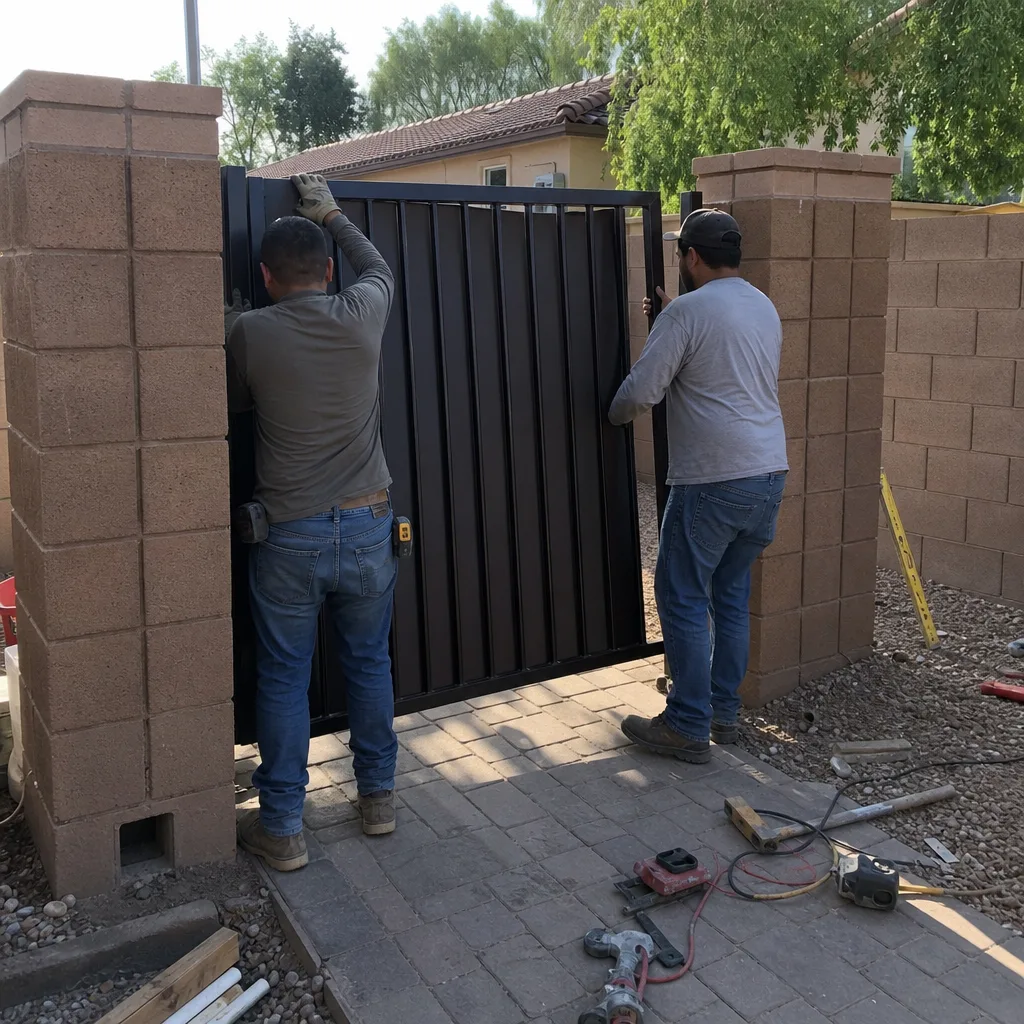
Most emergency calls we handle in Gilbert are preventable with annual Gate Repair services. The maintenance interval compresses to every 6 months for operators in direct sun or high-dust exposure (near agricultural areas, construction zones, or unpaved roads).
Annual Maintenance Checklist
- Hinge and roller lubrication. We use lithium-based grease, not WD-40, which attracts dust. In Gilbert’s environment, dry lubricant is preferable for exposed hinges.
- Operator force and limit verification. Test against calibrated standards, not “feels about right.” Document the settings in the photo record.
- Safety circuit testing. Photo-eye obstruction test, edge sensor test (if equipped), and auto-reverse force measurement. Arizona law requires functional auto-reverse on all automated gates.
- Electrical connection inspection. Torque terminals, inspect conduit seals, measure supply voltage under load.
- Structural fastener check. Post bolts, hinge bolts, track anchors. Re-torque to specification; replace any fastener showing thread deformation.
- Photo-eye lens cleaning and alignment. Clean with optical-grade solution, realign to manufacturer spec, verify beam interruption response.
Annual maintenance typically runs $180-$280 for a single residential gate in Gilbert. Compared to a $340 emergency call plus the inconvenience of a stuck gate, the math is straightforward. We schedule maintenance in spring (before heat stress) and fall (after monsoon season) for most Gilbert customers; see our Seasonal Gate Repair Care for Gilbert: Year-Round Homeowner’s Guide for details.
Common Mistakes to Avoid
- Ignoring a symptom because “it’s still working.” In Gilbert’s heat, working today means failing in 14-21 days, not months. The repair cost doesn’t increase if you call early, but the scheduling flexibility does.
- Describing the problem as “the motor is bad” without evidence. Motors fail less frequently than controls, gears, or structural issues. A precise symptom description saves diagnostic time and money.
- Applying generic lubricant to dusty hinges. WD-40 and similar products attract and bind dust in Gilbert’s environment, accelerating wear. Use dry or lithium-based lubricants specified for gate hardware.
- Resetting limits without checking why they drifted. Limits drift for a reason: mechanical binding, voltage fluctuation, or component failure. Resetting without diagnosis guarantees recurrence.
- Assuming all gate companies document their work. Most do not. Ask specifically: “Will I receive a written record and photos of what was found and adjusted?” Under Haven Standard Clause 4, we provide this on every visit; it’s not an upgrade or add-on.
- Delaying repair until after summer. A gate that struggles in June will likely fail in July’s peak heat. The emergency call premium and scheduling difficulty both increase.
When to Call a Professional
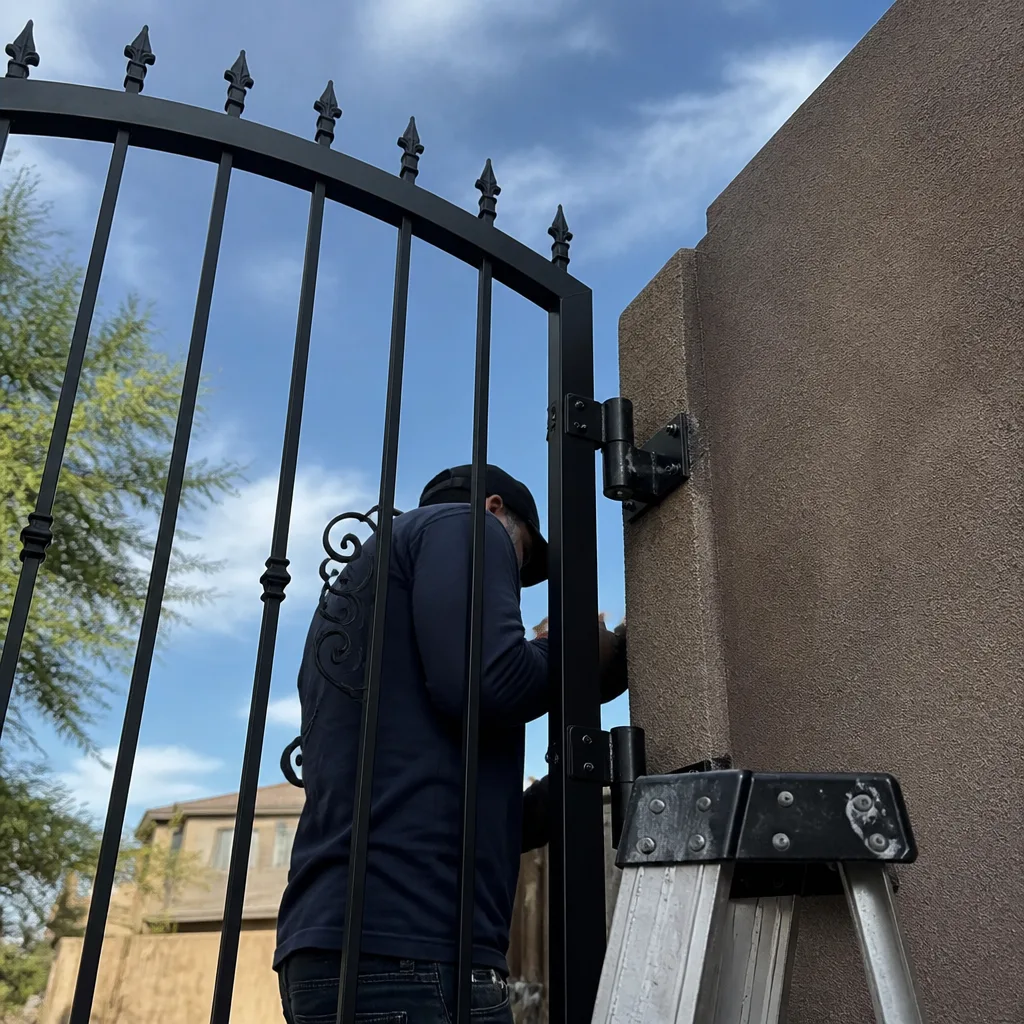
Call when you observe any safety-risk symptom listed above, when a stable symptom begins worsening, or when you cannot confidently distinguish operator from structural issues. The cost of misdiagnosis - replacing an operator when the post is failing, or vice versa - far exceeds the cost of professional assessment.
Vance Gate Repair Gilbert offers free estimates in Gilbert. A technician arrives with a multimeter, level, and camera, documents what we find, and delivers a written price before any work starts. If you have a written estimate from another company, we’ll review it at no cost under our second-opinion policy. Call (520) 482-3109; a live person answers 24 hours a day.
Frequently Asked Questions
Most residential gate repairs in Gilbert range from $140 to $480, with operator replacements running $680-$1,200 depending on brand and features. We provide a written, itemized quote before any work begins under Haven Standard Clause 1. Call (520) 482-3109 for a free estimate at your property.
Many motor problems are repairable: capacitor failure, gear wear, and control board issues are all fixable at component level. We replace motors only when the stator or rotor is damaged, bearings are seized, or the unit is obsolete with no parts availability. Our documentation habit means we can show you exactly why repair or replacement is the right call.
Overnight temperature drop causes metal contraction. A hinge with marginal clearance binds when cold, then frees as the sun warms the gate. In Gilbert’s desert climate, this pattern is common October through April. The underlying wear is present year-round; the symptom is just more visible with temperature swing.
A quality residential operator in shaded, maintained conditions typically lasts 12-15 years. In direct Gilbert sun with minimal maintenance, expect 7-10 years. Heat is the primary accelerator; every 10°F above rated ambient roughly halves electronic component life. Annual maintenance extends lifespan measurably.
A photo-eye is an infrared beam across the gate path; interruption reverses or stops the gate. A loop detector senses vehicle mass via a wire embedded in the driveway; it holds the gate open while a vehicle is present. Photo-eyes are required for all automated gates; loop detectors are common on commercial installations and some high-end residential systems in Gilbert’s gated communities.
We service nine major automation brands: LiftMaster, FAAC, BFT, Linear, Viking, Ghost Controls, DoorKing, Elite, and Mighty Mule. We don’t steer customers toward replacement with our preferred brand; we repair what’s installed and document why. If replacement is genuinely the better option, we quote multiple brands with written specifications for each.
The Bottom Line
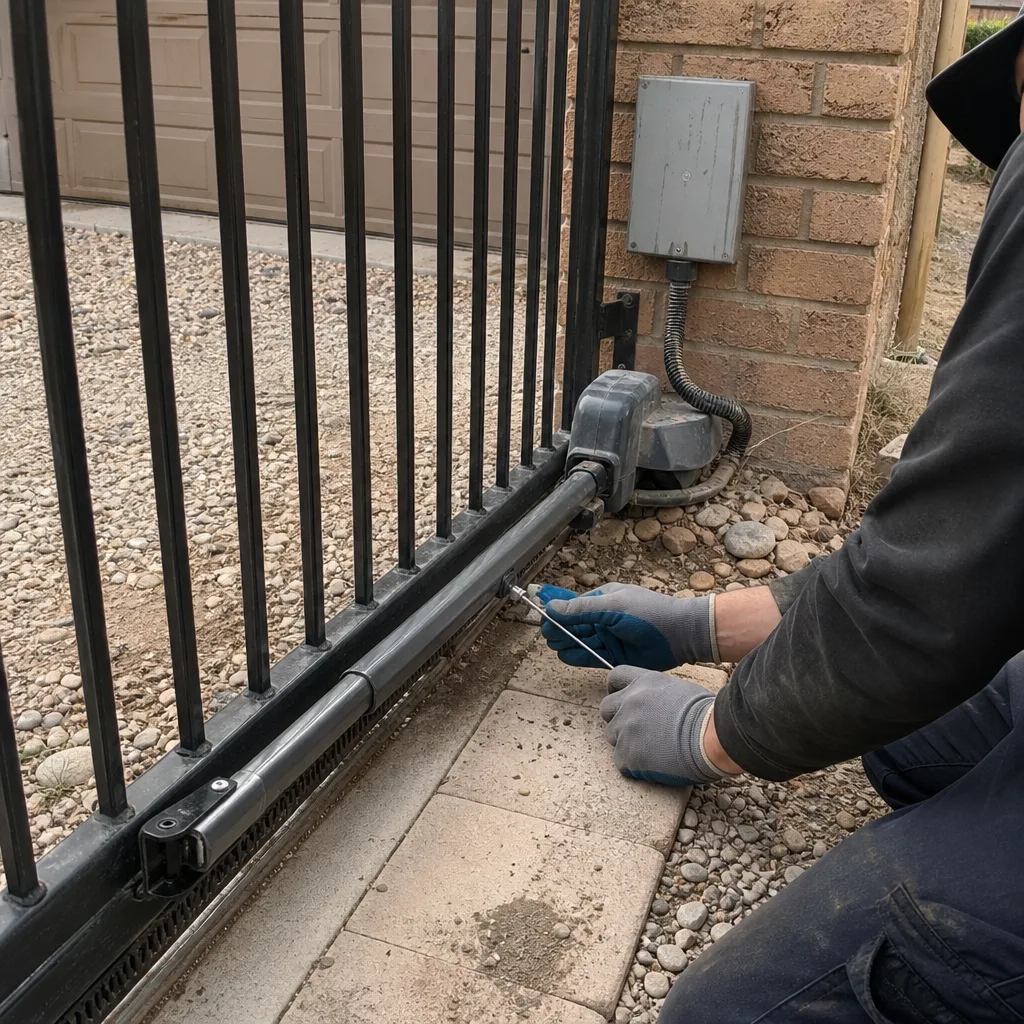
Gate failures communicate through specific, observable symptoms: hesitation duration, sound location, travel consistency, and remote behavior. In Gilbert’s climate, these warnings compress from months to weeks during summer heat. The homeowner who measures, photographs, and describes precisely gets faster diagnosis, accurate pricing, and repair that lasts. The homeowner who waits for total failure gets emergency rates, limited scheduling, and the risk that a simple fix has become a major rebuild. Document what you observe, call when symptoms are stable and predictable, and demand written evidence of what was found and fixed. For more guides & resources, visit our blog.
Vance Gate Repair Gilbert home | Gate Repair in Gilbert | Gate Installation in Gilbert | Gate Motor & Opener in Gilbert
Written by Adrian Vance, Owner at Vance Gate Repair Gilbert, serving Gilbert since 2014.